Achieving Excellence: How to Reach Ra 0.4 Surface Finish in Precision CNC Turning
In the realm of high precision machining, the quality of a component is often judged by its surface integrity. For many mission-critical cnc precision turning components, a surface finish of Ra 0.4 μm (16 micro-inches) is the gold standard. Achieving this level of smoothness consistently requires more than just high-end machinery; it requires a deep technical understanding of the interplay between cutting physics and material science.
As engineering consultants, we often see manufacturers struggle with “chatter” or inconsistent finishes. Here is the technical breakdown of how to master the Ra 0.4 threshold.
1. The Geometry of the Tool: Radius and Edge Prep
The theoretical surface finish ($R_a$) in turning is primarily dictated by the tool nose radius ($r_\epsilon$) and the feed rate ($f$). The mathematical relationship is expressed as:
$$R_a \approx \frac{f^2}{32 \cdot r_\epsilon}$$
To achieve a finer finish:
- Increase the Nose Radius: A larger radius creates a wider “overlap” between passes, smoothing out the peaks and valleys left by the tool.
- Wiper Technology: For ultra-precision, we utilize Wiper Inserts. These have a specialized edge geometry that flattens the peaks of the feed marks, allowing for a superior finish even at higher feed rates.
- Sharpness vs. Honing: For materials like Aluminum or Brass, a dead-sharp edge is required. For harder steels, a slight micro-hone is necessary to prevent edge chipping, which would otherwise create streaks on the finished part.
2. The Feed Rate: The Precision Balance
While the formula suggests that the lowest possible feed rate yields the best finish, there is a “point of diminishing returns.” If the feed rate is too low (less than the tool’s edge radius), the tool begins to rub rather than cut.
Rubbing leads to:
- Work Hardening: Especially in stainless steels.
- Increased Heat: Which can cause dimensional instability.
- Poor Aesthetic: A “cloudy” or torn look rather than a mirror finish.
In our facility, we calibrate the feed rate to be approximately 0.05mm to 0.1mm per revolution for Ra 0.4 finishes, ensuring we stay within the “sweet spot” of the tool’s chip-breaking capability.
3. Material Hardness and Chip Control
The “machinability” of a metal significantly impacts the final surface finish.
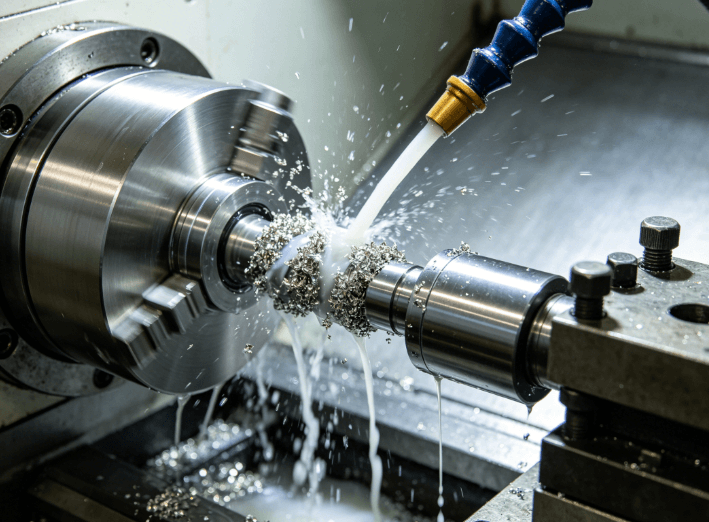
- Softer Materials (Ductile): Metals like 6061 Aluminum or 300-series Stainless Steel are prone to Built-Up Edge (BUE). BUE occurs when small particles of the material weld themselves to the tool tip, causing a jagged surface. We combat this with high-pressure coolant and specialized PVD coatings.
- Harder Materials: Hardened tool steels or heat-treated alloys often yield a better finish because they “snap” clean during chip formation. However, they require rigid setups and high-torque spindles to prevent vibration.
4. Why Machinery Rigidity Matters
No matter how perfect the tool, a Ra 0.4 finish is impossible without absolute rigidity. This is where high precision machining equipment, such as Swiss-type lathes, proves its value.
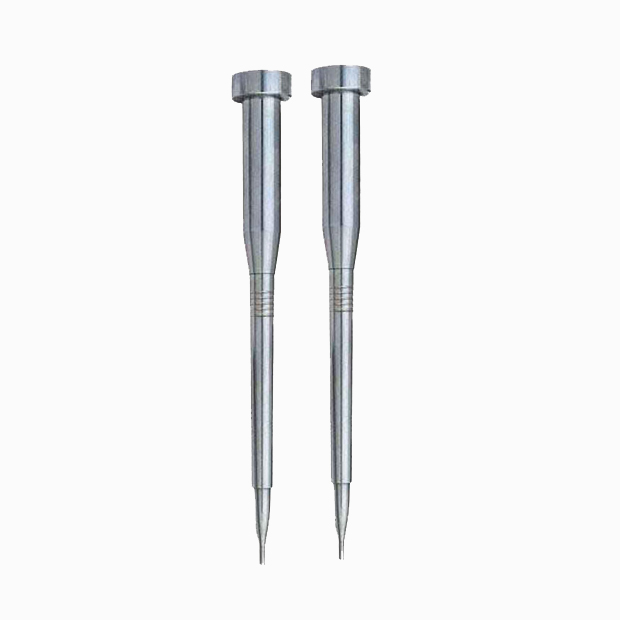
Because the sliding headstock supports the workpiece right at the point of the cut, deflection is virtually eliminated. This stability is what allows us to produce long, slender cnc precision turning components—such as guide pins or micro-shafts—with a consistent, mirror-like finish from one end to the other.
The Expertise at Your Service
At our factory, achieving Ra 0.4 is not an accident; it is a calculated result. Our expertise in precision mold components means we understand that surface finish is not just about “looking good”—it is about reducing friction, preventing wear, and ensuring long-term functional reliability.
By combining advanced tool path strategies with rigorous quality inspection (using surface profilometers), we ensure that every part meets the aesthetic and technical requirements of the most demanding global industries.
Looking for high-quality precision turning components? Check out our [Turning Services] page. For technical inquiries or to send a drawing for a quote, please contact us at milla@gunri.com.cn.