How to Choose Self-Lubricating Bearings for Industrial Machinery
Introduction
Bearings are small components, but they have a major impact on the reliability and service life of mechanical equipment. In many industrial environments, traditional lubricated bearings are not always practical. Dust, high loads, inaccessible installation positions, or maintenance limitations can make regular lubrication difficult or even impossible.
Self-lubricating bearings were developed to solve these problems. By integrating lubricating materials directly into the bearing structure, these components can operate with little or no external lubrication. As a result, they are widely used in construction machinery, automotive systems, heavy equipment, molds, and automation systems.
However, selecting the correct self-lubricating bearing is not always straightforward. Engineers must consider load capacity, operating speed, temperature, environmental conditions, and the characteristics of the shaft material. A bearing that performs well in one application may fail quickly in another if the working conditions are not properly evaluated.
This article explains how self-lubricating bearings work, where they are commonly used, and how engineers can select the most suitable type for their machinery.
What Is a Self-Lubricating Bearing
A self-lubricating bearing is a plain bearing designed to operate without external grease or oil. The lubrication is built into the bearing material itself. During operation, a thin lubricating film forms between the shaft and the bearing surface, reducing friction and preventing metal-to-metal contact.
Several material technologies are used to create self-lubricating properties.
One common design uses a bronze or steel base material with embedded solid lubricants such as graphite or PTFE. Another design uses composite materials consisting of a steel backing, a porous bronze layer, and a PTFE-based sliding surface.
There are also polymer bearings made from engineered plastics that contain lubricating fillers.
The main goal of all these designs is the same: to maintain low friction and stable performance while eliminating the need for continuous lubrication.
Compared with rolling bearings, self-lubricating bearings are structurally simpler. They have no rolling elements, cages, or raceways. The load is supported by a sliding interface between the shaft and the bearing surface.
Because of this simple structure, they often perform well under heavy loads, shock loads, and slow oscillating motion.
How Self-Lubricating Bearings Work
The operating principle of a self-lubricating bearing is based on the formation of a stable low-friction layer between the shaft and the bearing surface.
Different types of bearings achieve this effect in different ways.
Solid Lubricant Bearings
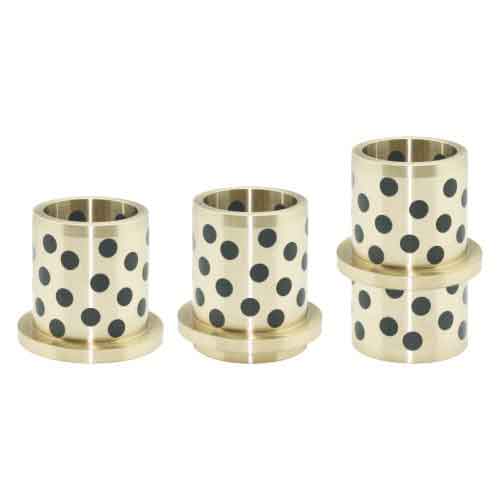
In bronze graphite bearings, small graphite plugs are embedded throughout the bearing body. Graphite is a natural solid lubricant with a layered crystal structure that allows easy sliding between layers.
When the shaft moves against the bearing surface, microscopic amounts of graphite are transferred to the contact interface. This creates a thin lubricating film that reduces friction and wear.
These bearings are commonly used in heavy equipment where loads are high and lubrication intervals are long.
Composite Self-Lubricating Bearings
Composite bearings typically consist of three layers:
- A steel backing that provides strength and dimensional stability
- A porous bronze layer that bonds the surface layer to the backing
- A PTFE-based sliding layer that provides the low-friction surface
During operation, PTFE gradually transfers onto the shaft surface. This transfer film creates a smooth sliding interface that significantly reduces friction.
This type of bearing performs well in applications requiring low friction and maintenance-free operation.
Polymer Bearings
Some self-lubricating bearings are made from engineered plastics such as POM, PTFE blends, or other polymer compounds.
These materials contain lubricating fillers distributed throughout the structure. As the surface wears, new lubricating particles are exposed, maintaining low friction over time.
Polymer bearings are often used in light-to-medium load applications where corrosion resistance or chemical resistance is important.
Applications of Self-Lubricating Bearings in Industry
Self-lubricating bearings are widely used in industrial equipment where traditional lubrication is difficult or undesirable.
Construction Machinery
Excavators, loaders, and cranes frequently operate in dusty and abrasive environments. Dirt contamination can quickly degrade conventional lubricated bearings.
Bronze graphite bushings are commonly used in boom joints, bucket linkages, and pivot points. The solid lubricant allows reliable operation even when maintenance intervals are long.
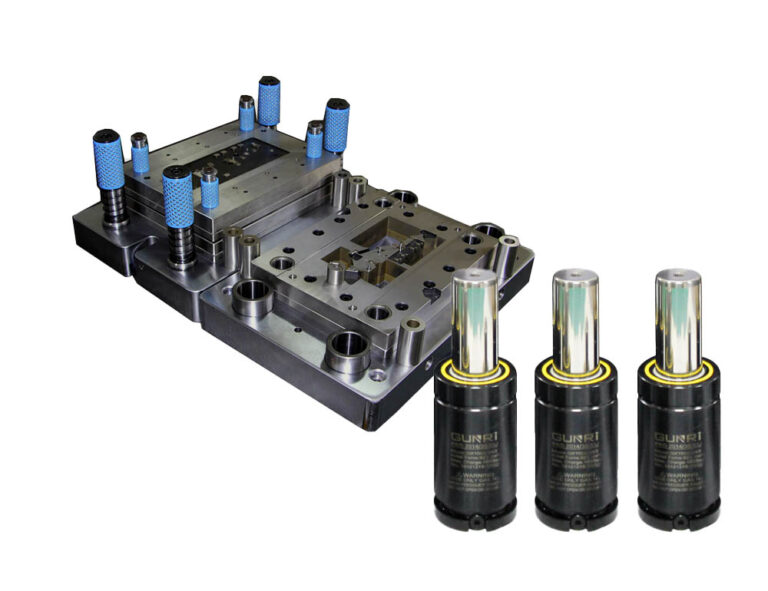
Injection Molds and Die Sets
In mold systems, guide pillars and sliding components require precise movement and reliable positioning. Applying grease is often undesirable because it can contaminate molded products.
Self-lubricating bearings are commonly used in mold guide components to maintain smooth sliding while keeping the working area clean.
Automotive Systems
Automotive components often require long service life with minimal maintenance. Self-lubricating bearings are used in:
- suspension components
- seat adjustment systems
- steering mechanisms
- door hinges
The ability to operate without regular lubrication helps reduce maintenance requirements over the life of the vehicle.
Industrial Automation
Automation equipment often includes linear slides, pivot arms, and robotic joints that perform repetitive motion cycles.
Composite self-lubricating bearings are frequently used in these systems because they offer low friction and quiet operation.
Agricultural Machinery
Farm equipment is exposed to mud, dust, and moisture. In these conditions, grease can easily wash away or attract contaminants.
Self-lubricating bearings provide a practical solution for pivot points and linkage systems.
Advantages of Self-Lubricating Bearings
Self-lubricating bearings offer several practical advantages in industrial applications.
Reduced Maintenance
The most obvious benefit is the elimination of routine lubrication. Equipment can operate for long periods without grease fittings or maintenance access.
This is particularly valuable in locations that are difficult to reach.
Improved Reliability in Dirty Environments
Grease can attract dust and abrasive particles. In harsh environments, this contamination can accelerate wear.
Self-lubricating bearings reduce this risk because they do not rely on external lubricants.
High Load Capacity
Plain bearings typically distribute load over a larger contact area compared with rolling bearings. As a result, many self-lubricating bearings handle heavy loads effectively.
This makes them suitable for construction machinery and heavy equipment.
Good Performance in Oscillating Motion
Rolling bearings can struggle with small oscillating movements because the rolling elements may not rotate fully.
Self-lubricating bushings perform well in oscillating applications since the motion occurs through sliding contact.
Compact Design
Without rolling elements, these bearings can be designed with thinner walls and simpler structures. This helps reduce space requirements in compact mechanical designs.
Common Problems and Failures
Despite their advantages, self-lubricating bearings are not immune to failure. Most problems arise from incorrect selection or improper installation.
Excessive Load
Every bearing material has a maximum pressure-velocity limit, often referred to as the PV value.
If the combined load and speed exceed this limit, the bearing surface may overheat and wear rapidly.
Engineers should always verify that the operating conditions fall within the recommended PV range.
Shaft Surface Problems
The shaft plays a critical role in bearing performance.
If the shaft surface is too rough, it can accelerate wear. If it is too smooth, the transfer film may not form properly.
Typical recommended shaft roughness is between Ra 0.2 and Ra 0.8 micrometers, depending on the bearing type.
Shaft hardness is also important. A soft shaft may wear quickly, especially when used with bronze bearings.
Misalignment
Plain bearings tolerate some misalignment, but excessive misalignment concentrates load on one side of the bearing.
This can lead to uneven wear and premature failure.
Proper machining of the housing and accurate installation are essential.
Temperature Effects
High temperatures can degrade polymer or PTFE materials.
When operating temperatures exceed material limits, the sliding layer may soften or deteriorate.
In high-temperature environments, metal-based bearings with solid lubricants are often a better choice.
Contamination
Although self-lubricating bearings handle dirty environments better than lubricated bearings, abrasive particles can still cause wear.
Seals, covers, or protective design features can help extend service life.
How to Choose the Right Self-Lubricating Bearing
Selecting the correct bearing requires careful evaluation of several factors.
Load Conditions
The first step is determining the load acting on the bearing.
This includes:
- static load
- dynamic load
- shock load
Heavy loads generally favor metal-based bearings such as bronze graphite bushings.
Sliding Speed
Speed affects the formation of the lubricating film and the heat generated during operation.
Low-speed applications often work well with solid lubricant bearings. Higher speeds may require composite or polymer bearings with lower friction.
Temperature Range
Operating temperature influences material selection.
PTFE-based composite bearings typically handle temperatures up to around 250 °C for short periods. Polymer bearings usually have lower limits.
Metal bearings with graphite lubricants can withstand higher temperatures.
Environment
Environmental conditions are another important factor.
Engineers should consider:
- dust and contamination
- water exposure
- chemicals
- corrosion risk
Polymer bearings are often chosen for corrosive environments, while bronze bearings are preferred for heavy mechanical loads.
Shaft Material
The shaft material must be compatible with the bearing surface.
Hardened steel shafts are commonly recommended for composite bearings. Bronze bearings may require higher shaft hardness to prevent wear.
Installation Design
Housing design also influences bearing performance.
Proper interference fit, alignment, and support are necessary to prevent deformation or movement of the bearing inside the housing.
Designers should also consider thermal expansion and installation clearances.
Frequently Asked Questions
What is a self-lubricating bearing?
A self-lubricating bearing is a type of plain bearing designed to operate without external oil or grease. The bearing material contains solid lubricants or low-friction layers that create a lubricating film during operation.
What are the advantages of self-lubricating bearings?
Self-lubricating bearings reduce maintenance requirements, perform well in dusty environments, and can handle heavy loads and oscillating motion.
Where are self-lubricating bearings commonly used?
They are widely used in construction machinery, molds, automotive systems, agricultural equipment, and industrial automation.
What is the PV value of a bearing?
PV value represents the product of pressure and sliding velocity. It is used to determine the operating limits of plain bearings.
Conclusion
Self-lubricating bearings offer a practical solution for many industrial applications where traditional lubrication is difficult or undesirable. By integrating lubricating materials directly into the bearing structure, these components reduce maintenance requirements and improve reliability in demanding environments.
However, selecting the correct bearing requires a clear understanding of operating conditions. Load, speed, temperature, shaft material, and environmental factors all influence performance.
When these parameters are carefully evaluated, self-lubricating bearings can provide long service life and stable operation in machinery ranging from construction equipment to precision automation systems.