Self Lubricating Bushings for Automation Equipment Sliding Systems
Introduction
Sliding systems in automation equipment don’t fail because of design mistakes most of the time. They fail because someone assumed maintenance would be easy.
It isn’t.
Linear slides inside assembly machines, pick-and-place units, and precision fixtures are often enclosed, compact, and hard to access. Once the machine is running in a production line, nobody wants to stop it just to re-grease a guide or replace a worn bearing.
And in many cases, you can’t use grease at all.
Clean environments. Dust-sensitive products. Optical or electronic assembly. Oil contamination is not acceptable.
That’s where graphite bronze bushings start to make practical sense.
Working Conditions / Problem Background
Automation equipment doesn’t operate in extreme conditions like mining or heavy forging, but the challenges are different—and often more restrictive.
Typical sliding system conditions include:
Limited Maintenance Access
Slides are often buried inside:
- Enclosed machine frames
- Multi-axis modules
- High-speed automation lines
Once installed, access requires partial disassembly. In real production environments, this simply doesn’t happen on schedule.
Clean or Controlled Environments
In industries like:
- Electronics assembly
- Semiconductor handling
- Medical device production
Lubricants are a problem. Oil mist, grease migration, or contamination can:
- Affect product quality
- Interfere with sensors
- Attract dust and debris
Moderate Load, High Precision Requirements
Loads are usually not extreme, but precision matters:
- Repeated positioning accuracy
- Smooth sliding without stick-slip
- No variation over time
Even small increases in friction or clearance show up as positioning errors.
Continuous Cycling
Automation doesn’t rest:
- High cycle counts
- Short stroke reciprocating motion
- Frequent starts and stops
This combination is hard on traditional lubrication films.
Why Traditional Solutions Fail
Engineers often default to linear bearings or greased bronze bushings. On paper, they work. In practice, they introduce problems.
Grease-Lubricated Bronze Bushings
Grease seems like a simple solution. It isn’t.
- Grease dries out over time
- It gets pushed away from contact zones in short-stroke motion
- Dust sticks to it and forms abrasive paste
In enclosed automation systems, re-lubrication intervals are rarely followed. What you get is:
- Increased friction
- Uneven wear
- Loss of precision
And eventually, seizure.
Linear Ball Bearings
Ball bearings provide low friction, but they come with trade-offs:
- Sensitive to contamination
- Require clean lubrication
- Poor performance under oscillating motion
Short-stroke movement is especially problematic. Balls don’t circulate properly, leading to localized wear.
Also, they don’t tolerate misalignment well. In real machines, perfect alignment doesn’t exist.
Polymer Bushings
Plastic or composite bushings are used for dry operation, but:
- Load capacity is limited
- Thermal expansion can affect clearance
- Long-term dimensional stability is inconsistent
In precision automation, that last point matters. A few microns of change can affect repeatability.
Why Graphite Bronze Bushings Work
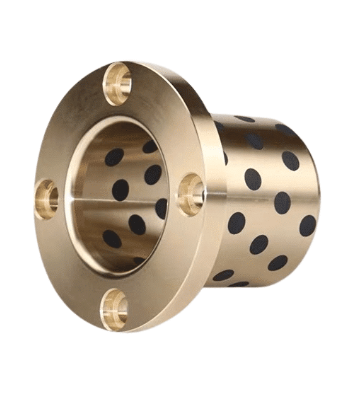
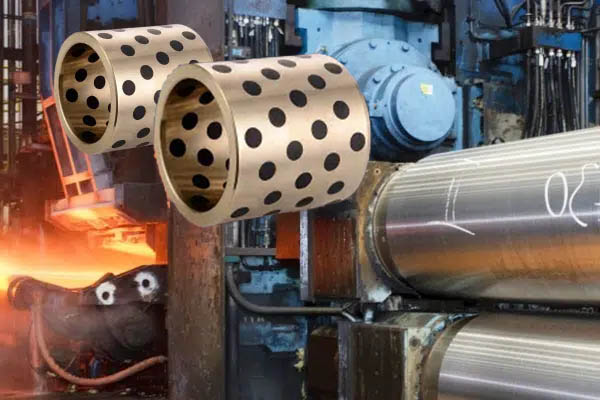
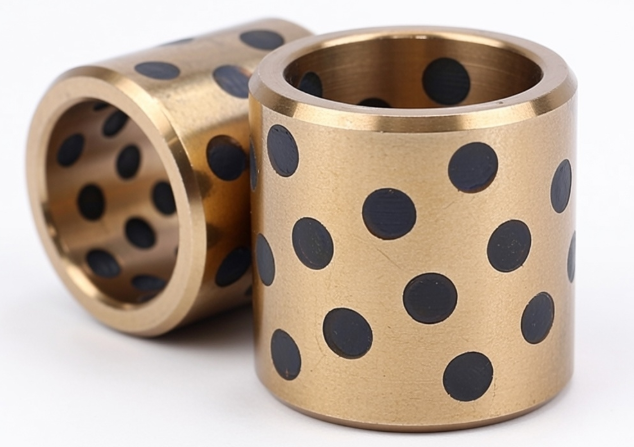
Graphite bronze bushings, also known as oilless bushings or self lubricating bushings, solve these issues by changing how lubrication is delivered.
Material Structure
These bushings are typically made from:
- High-strength bronze base (often CuSn alloys)
- Embedded solid graphite plugs or inserts
The bronze handles:
- Load
- Structural stability
- Wear resistance
The graphite provides:
- Continuous solid lubrication
- Low friction without oil or grease
Self-Lubrication Mechanism
Under sliding motion:
- Contact pressure exposes graphite at the surface
- Graphite forms a thin transfer film on the mating shaft
- This film reduces friction and prevents metal-to-metal contact
No external lubricant required.
No re-greasing cycles.
No contamination risk.
Performance in Short-Stroke Motion
This is where graphite bronze bushings outperform many alternatives.
Because lubrication is built into the material:
- There is no dependency on lubricant distribution
- No starvation zones
- No breakdown of grease film
Even in repetitive, short-stroke movements, performance remains stable.
Tolerance to Misalignment
Unlike rolling elements, bronze bushings can tolerate slight misalignment.
In real automation systems:
- Assembly tolerances vary
- Thermal expansion shifts components
- Frames deform under load
Graphite bronze bushings handle this without localized stress concentrations.
Key Benefits in This Application
Clean Operation
No oil. No grease.
That alone solves multiple problems:
- No contamination of sensitive products
- No oil mist affecting sensors or optics
- No dust accumulation due to sticky lubricants
For clean environments, this is often the deciding factor.
Stable Precision Over Time
Because there is:
- No lubricant degradation
- No uneven wear due to dry spots
You get consistent friction behavior.
This translates to:
- Stable positioning accuracy
- Predictable motion
- Reduced calibration drift
In automation, consistency matters more than absolute low friction.
Reduced Maintenance
No lubrication schedule.
No risk of missed maintenance.
This is critical for:
- 24/7 production lines
- Remote installations
- Equipment with difficult access points
Downtime drops. Maintenance labor drops.
Long Service Life
Graphite bronze bushings wear slowly under proper conditions.
Especially in:
- Moderate load
- Controlled sliding speeds
- Clean environments
Service life is often longer than greased systems that suffer from lubrication failure.
Resistance to Contamination
Dust is less of a problem because:
- There is no grease to trap particles
- Graphite film does not attract debris the same way
This reduces abrasive wear significantly.
Practical Considerations
Graphite bronze bushings are not a universal solution. Selection still matters.
Load and Pressure
Check:
- Surface pressure (PV value)
- Static vs dynamic load
Bronze handles higher loads than polymer, but limits still exist.
For automation slides, loads are usually well within range—but don’t assume.
Sliding Speed
These bushings perform best at:
- Moderate speeds
- Reciprocating motion
Very high speeds may require different solutions due to heat generation.
Shaft Material and Finish
The mating shaft is critical.
Recommended:
- Hardened steel shaft
- Surface finish around Ra 0.4–0.8 µm
Too rough:
- Accelerates wear
Too smooth:
- Reduces graphite film formation
Operating Temperature
Graphite bronze bushings perform well across a wide temperature range.
Typical advantages:
- No viscosity change (unlike oil)
- Stable friction characteristics
Useful in:
- Enclosed machines with heat buildup
- Environments where temperature fluctuates
Installation Fit
Pay attention to:
- Proper interference fit in housing
- Correct clearance with shaft
Too tight:
- Increases friction
Too loose:
- Reduces precision
This directly affects performance in automation systems.
Motion Type
Best suited for:
- Linear sliding
- Oscillating motion
Not ideal for:
- High-speed continuous rotation
Match the bushing type to motion profile.
In automation sliding systems, the real problem isn’t friction—it’s consistency without maintenance.
Grease fails quietly. Bearings fail suddenly. Both disrupt production.
Graphite bronze bushings remove that variable.
If you’re dealing with unstable precision, frequent maintenance, or contamination concerns in your sliding systems, it’s worth reviewing your current design.
Need high-quality mold or stamping die components? Browse our product range or contact us for custom solutions.