DIN 6325 vs DIN 7979: Dowel Pin Comparison Guide
What Are DIN 6325 and DIN 7979 Dowel Pins?
DIN 6325 and DIN 7979 are two commonly used dowel pin standards defined by the German DIN system. Both are precision fasteners used for alignment, positioning, and load transfer in molds, stamping dies, jigs, CNC tooling, and automated assembly equipment. While they look similar at a glance, their design and intended applications differ in critical ways that affect how and where you should use them.
Choosing the wrong dowel pin can lead to alignment drift, increased downtime, or damage to your tooling. This expanded guide covers every aspect of DIN 6325 vs DIN 7979 to help you make the right selection.
Key Differences Between DIN 6325 and DIN 7979
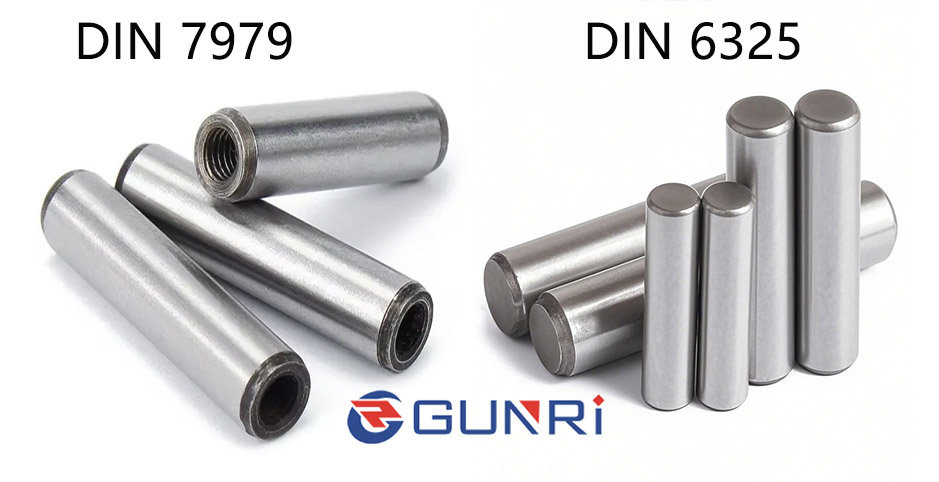
The fundamental difference is that DIN 6325 is a solid dowel pin designed for permanent installation, while DIN 7979 is a tapped (threaded) dowel pin designed for easy removal and reuse. Below is a full comparison:
| Feature | DIN 6325 | DIN 7979 |
| Structure | Solid body — no internal features | Hollow body with internal thread |
| Internal Thread | None | Yes — typically M3 to M20 |
| Removal Method | Drilled out or pressed out (difficult) | Extraction bolt threaded into internal thread |
| Reusability | Not designed for reuse after removal | Designed for repeated removal and reinstallation |
| Cost | Lower — simple manufacturing | Higher — additional machining required |
| Diameter Range | 1 mm to 50 mm | 3 mm to 30 mm |
| Tolerance | h6 (standard), h7 (optional) | h6 (standard) |
| Material | Carbon steel, bearing steel, stainless steel | Carbon steel, alloy steel, stainless steel |
| Surface Hardness | 58–64 HRC (case-hardened) | 58–64 HRC (case-hardened) |
Specifications and Dimensions
DIN 6325 — Solid Dowel Pins
DIN 6325 pins are hardened ground dowel pins manufactured to tight h6 tolerance. They come in diameters from 1 mm to 50 mm and lengths from 2 mm to 200 mm (custom lengths available on request). The standard material is case-hardened bearing steel (SUJ2 / 100Cr6) with a case depth of 0.5–1.5 mm and core hardness of 30–45 HRC.
Available versions:
- Unhardened (for re-machining after installation)
- Through-hardened (58–62 HRC throughout)
- Case-hardened (58–64 HRC surface, tough core)
- Stainless steel (for corrosion-resistant environments)
DIN 7979 — Tapped Dowel Pins
DIN 7979 (also known as “threaded dowel pins” or “tapped dowel pins”) have the same outer dimensions and h6 tolerance as DIN 6325 but feature an internal thread for bolt extraction. The thread size follows standard coarseness: M3, M4, M5, M6, M8, M10, M12, M16, and M20. Common diameters range from 3 mm to 30 mm
Thread size by diameter (typical):
| Pin Diameter (mm) | Internal Thread | Thread Depth (mm) |
| 6 | M4 | 8 |
| 8 | M5 | 10 |
| 10 | M6 | 12 |
| 12 | M8 | 16 |
| 16 | M10 | 20 |
| 20 | M12 | 24 |
Material Comparison: Which Steel Is Best?
Dowel pins are available in several steel grades. The choice depends on your application’s hardness, corrosion resistance, and cost requirements:
| Material | Hardness | Best For | Limitation |
| Bearing Steel (SUJ2 / 100Cr6) | 60–64 HRC | High-load stamping dies, mold bases | Not stainless — may rust |
| Carbon Tool Steel (SK95 / C105U) | 58–62 HRC | General-purpose alignment | Lower wear resistance |
| Stainless Steel (SUS304 / 1.4301) | ~25 HRC (not hardenable) | Food-grade, medical, cleanroom | Lower hardness |
| Nitrided Alloy Steel | 65–70 HRC surface | High-wear, high-cycle applications | Higher cost |
How to Choose Between DIN 6325 and DIN 7979
The decision comes down to one question: will you need to remove this dowel pin during the life of the tool?
Choose DIN 6325 (Solid) When:
- You need permanent alignment for mold bases or die sets that will not be disassembled
- You want the lowest-cost solution with maximum rigidity
- The application involves high shear forces (solid body transfers load better)
- You are building a one-piece tool with no planned maintenance access
Choose DIN 7979 (Tapped) When:
- You need easy disassembly for maintenance or component replacement
- Your tooling uses quick-change systems in CNC or jigs
- You are aligning hot runner manifolds or injection nozzles that require frequent access
- The pin must be removable without damaging the surrounding material
If you are unsure, a good rule of thumb: use DIN 6325 for permanent mold and die base alignment, and DIN 7979 for any alignment point that will be accessed during maintenance.
Common Applications
| Application | DIN 6325 | DIN 7979 |
|---|---|---|
| Injection mold base alignment | ✔ Core to base alignment | ✔ Hot runner components |
| Stamping die sets | ✔ Upper/lower die alignment | ✔ Detachable fixtures |
| CNC workholding | ✔ Fixed pallet alignment | ✔ Modular vice setups |
| Automation assembly cells | ❌ Not recommended | ✔ Quick-change fixtures |
| Inspection jigs and gauges | ❌ Not recommended | ✔ Removable locating pins |
Installation Guide: Step by Step
Proper installation is critical for both pin types to function correctly:
- Drill the hole to the recommended tolerance: H7 for standard applications (e.g., a 10 mm dowel pin requires a 10 mm H7 hole in the receiving part).
- Deburr the hole edges — sharp edges can shave material off the pin during insertion and affect interference fit.
- Apply light oil to the pin surface to prevent galling during press-fit.
- Press-fit the pin using an arbor press or hydraulic press — never hammer directly, as impact can distort the pin or damage the hole.
- For DIN 7979: after installation, check that the internal thread is clean and accessible. Use extraction bolts with a spacer washer when removing.
Common Mistakes and How to Avoid Them
Even experienced toolmakers make these errors:
| Mistake | Consequence | Solution |
| Using solid pins in serviceable locations | Difficult removal, risk of breaking the pin | Use DIN 7979 where removal is expected |
| Tapped pins in high-shear applications | Deformation around the hollow core | Use solid DIN 6325 for shear-critical joints |
| Wrong hole tolerance | Loose fit or impossible press-fit | Always verify H7 tolerance for standard h6 pins |
| Forgetting to deburr | Scored pin surface, improper fit | Deburr with a countersink or hand tool |
Frequently Asked Questions
Can I use DIN 7979 in place of DIN 6325?
In low-shear applications, yes — but the hollow body of DIN 7979 has lower shear strength than a solid DIN 6325 pin of the same diameter. For critical structural alignment, use solid pins.
What tolerance is a DIN 6325 dowel pin?
Standard DIN 6325 and DIN 7979 dowel pins are manufactured to h6 tolerance (e.g., a nominal 10 mm pin will measure between 9.991 mm and 10.000 mm). The recommended receiving hole tolerance is H7.
Are DIN 6325 and DIN 7979 the same as ISO 8734 and ISO 8735?
Yes. DIN 6325 is equivalent to ISO 8734 (solid dowel pins), and DIN 7979 is equivalent to ISO 8735 (tapped dowel pins). The ISO standards superseded the DIN standards in most international contexts, but the DIN numbers remain widely used in tooling.
How do I remove a stuck DIN 6325 dowel pin?
If a solid pin is stuck, drill a small hole into the center of the pin and use a bolt extractor. Alternatively, drill through the entire pin and press it out from the opposite side. For future maintenance, consider switching to DIN 7979 in that location.
What is the maximum length for a DIN 7979 tapped dowel pin?
Tapped dowel pins are typically available from 6 mm to 100 mm in length. Longer lengths are possible with custom manufacturing but may require deeper thread engagement.
Where to Buy DIN 6325 and DIN 7979 Dowel Pins
We supply a full range of precision dowel pins in both DIN 6325 and DIN 7979 standards, along with custom sizes manufactured to your specifications:
- DIN 6325 — Solid Dowel Pins (1–50 mm diameter, any length)
- DIN 7979 — Tapped Dowel Pins (M3–M20 thread, 3–30 mm diameter)
- MSTM / MSTP / MS Series — Threaded mold-use pins for injection molds
- Custom sizes — Manufactured from your drawing with full heat treatment
All pins are ground to h6 tolerance, case-hardened to 58–64 HRC, and available in bearing steel, carbon steel, or stainless steel. Contact us for technical datasheets, free samples, or a quote for custom sizes.
Email: milla@gunri.com.cn
Explore our full range of dowel pins and guide components or contact our engineering team for custom manufacturing support.