Industry Applications
Industrial Machinery & Automation
In continuous manufacturing, our plates protect conveyor systems, hydraulic pumps, gearboxes, and chain drives. They prevent contamination from dust and debris while eliminating metal-to-metal contact in hard-to-reach areas.
Automotive & Electric Vehicles (EVs)
Engineered for sealed and zero-maintenance vehicle assemblies, providing consistent friction control and noise reduction in brake linkages, suspension joints, steering systems, and transmission mechanisms.
Aerospace Engineering
Meeting stringent standards for safety and weight reduction, these plates offer zero lubricant migration or evaporation in high-altitude vacuums. Crucial for flight control actuators, landing gear, and door hinges.
Heavy Construction & Mining Equipment
Designed to withstand high-impact and abrasive environments. Strategically deployed in pivot points, boom joints, excavator buckets, and hydraulic cylinder rods to prevent galling and seizing under dirt and sand exposure.
Renewable Energy Systems
Optimized for remote offshore wind farms and desert solar tracking systems. They endure thermal cycling (-40°C to +80°C) and minimize costly service climbs for blade pitch and yaw mechanisms.
Railway & Transit Infrastructure
Ensures passenger comfort and system reliability under heavy vibration. Commonly installed in train sliding door mechanisms, couplers, and emergency brake rigging to lower mass transit lifecycle costs.
Technical FAQ
1. How do oilless wear plates work?
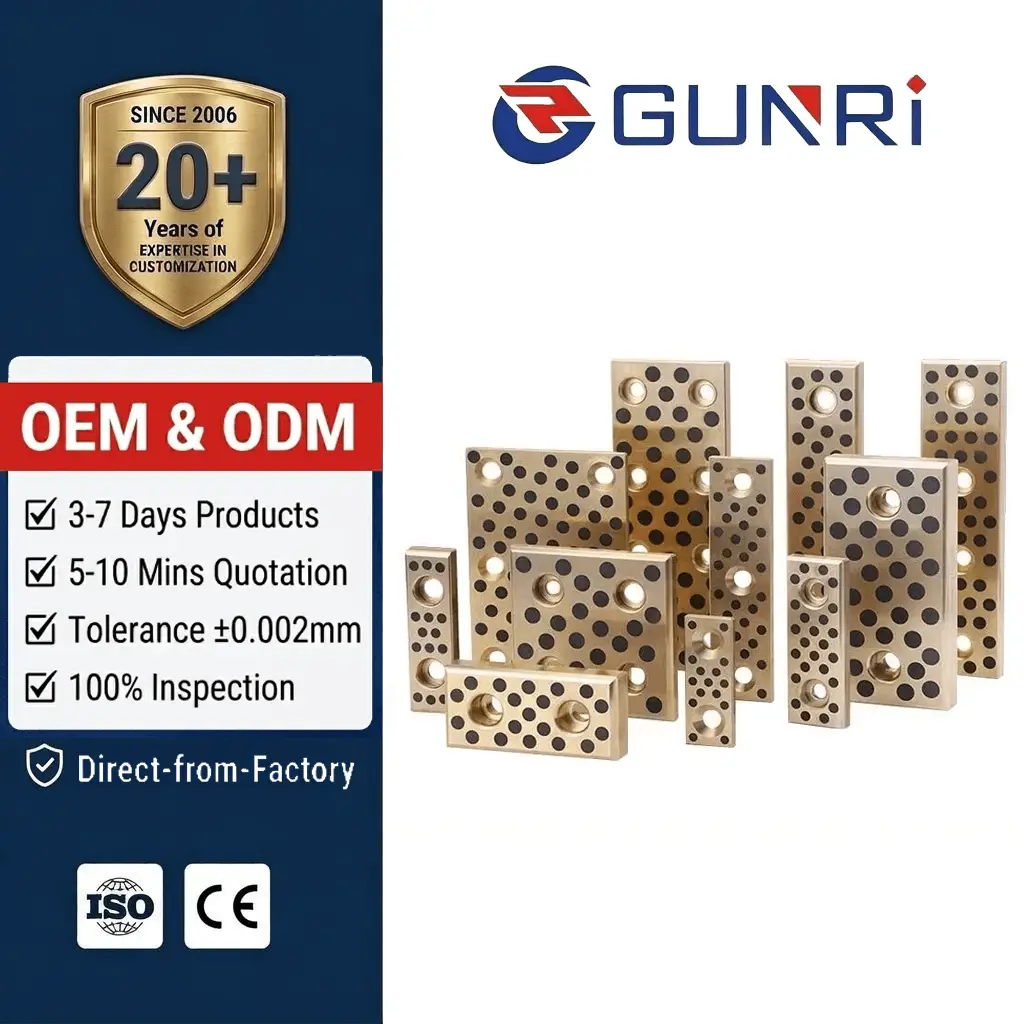
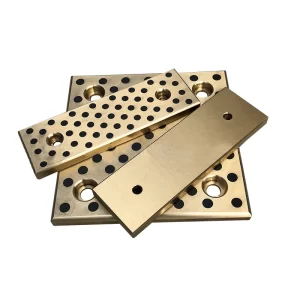
Embedded solid graphite plugs continuously transfer microscopic lubricant to the mating surface during operation, creating a self-replenishing dry film that eliminates manual greasing.
2. What is the expected lifespan?
- Light-duty/Automation: 5 to 10+ years.
- Medium-duty/Industrial: 2 to 5 years.
- Heavy-duty/Extreme environments: 6 months to 2 years (outperforming traditional steel parts by 30%–75%).
3. Can I get a custom size?
Yes. Send us your 2D (PDF/DWG) or 3D (STEP) drawings, and our engineers will provide a fast quote with precise custom tolerances.
4. Which bronze alloy should I choose for my wear plate?
The three most common alloys are C95400 aluminum bronze (high strength, high temp, corrosion resistant), C93200 SAE 660 bearing bronze (general purpose, economical), and C86300 manganese bronze (heavy impact, severe duty). For a detailed comparison of all three alloys plus selection criteria, see our graphite bronze wear plate alloy comparison guide.
5. How should I configure graphite plug size, pattern, and density for my wear plate?
The size, pattern, and density of graphite plugs directly affect load capacity, lubrication film thickness, and wear life. Larger plugs deliver more lubricant but reduce the bronze bearing surface area. Denser patterns (more plugs per area) provide smoother lubrication at the cost of structural strength. For a detailed guide covering plug diameter selection, row spacing, staggered vs. inline patterns, and density optimization for different loads, see our graphite plug configuration guide.