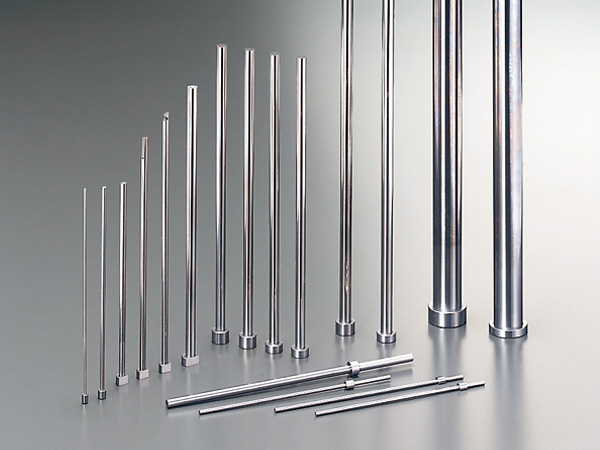
SKD61 vs. 65Mn Ejector Pins: Which Material is Best for Your Mold?
Introduction
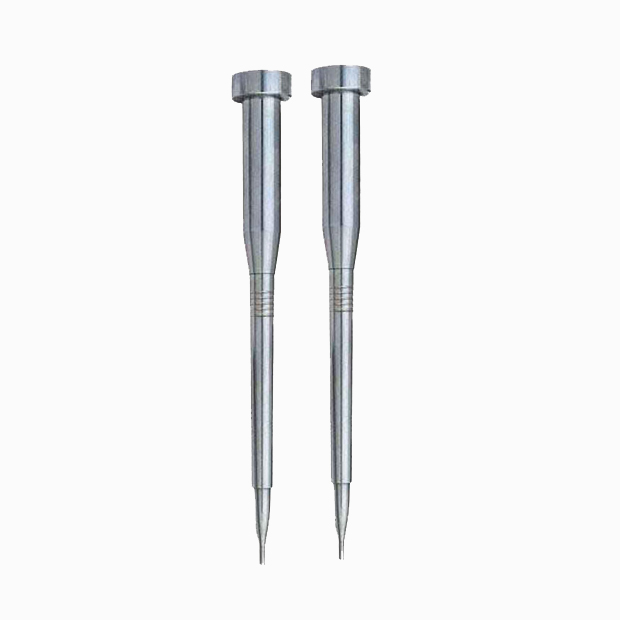
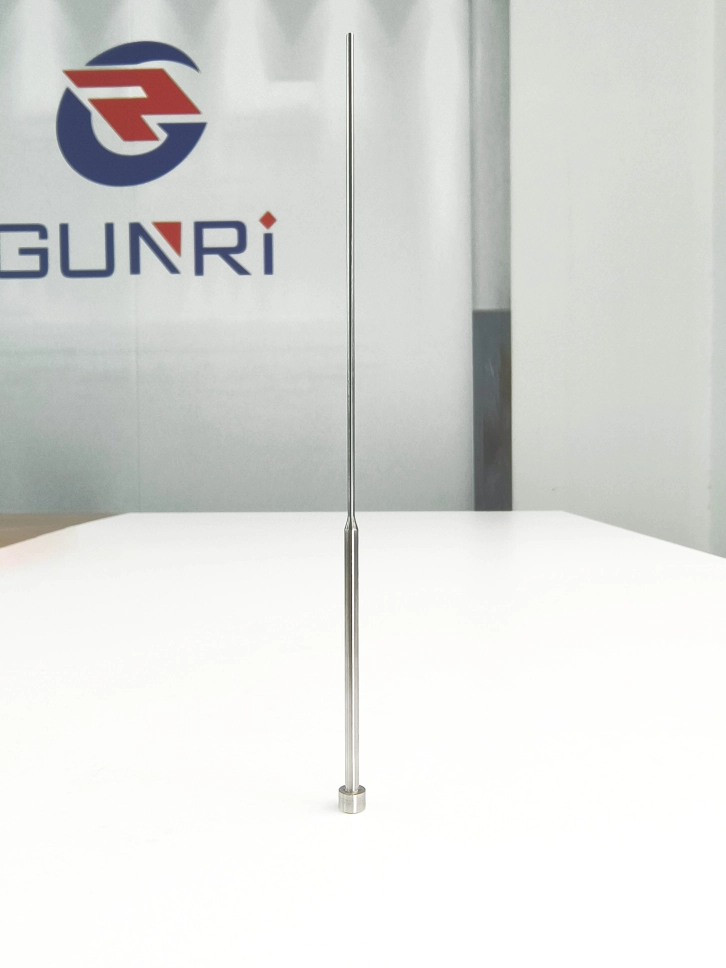
In the world of plastic injection and die-casting, the efficiency of a mold is often judged by its smallest components. Among these, ejector pins play a critical role in the final stage of the manufacturing cycle: ensuring the part is removed cleanly, quickly, and without damage. However, not all pins are created equal.
Choosing between SKD61 and 65Mn is one of the most common dilemmas for mold designers and procurement managers. While one offers unbeatable cost-effectiveness for simple projects, the other provides the thermal resilience required for high-tech industrial applications. This article will break down the fundamental differences between these two materials, helping you strike the perfect balance between initial investment and long-term production stability.
65Mn Ejector Pins: The Cost-Effective Basic Choice
For many standard molding applications, 65Mn (Manganese Steel) is the “go-to” material when budget and basic functionality are the top priorities. Known as a high-carbon spring steel, 65Mn offers a balanced mix of hardness and elasticity that makes it suitable for straightforward manufacturing tasks.
Key Characteristics of 65Mn
- High Elasticity: Thanks to its manganese content, these pins can withstand minor bending and stress without snapping immediately, providing a degree of flexibility during the ejection process.
- Decent Hardness: After heat treatment, 65Mn typically reaches a surface hardness of HRC 50–55. While not the hardest on the market, it is sufficient for ejecting most common plastics.
- Machining Ease: It is relatively easy to cut and shape, which keeps the manufacturing costs of the pins themselves very low.
Why Choose 65Mn?
The primary driver for selecting 65Mn is cost-efficiency. If you are running a “cold” mold (standard injection molding) where temperatures stay relatively low, and the plastic being used isn’t highly abrasive, 65Mn performs reliably. It is the ideal choice for:
- Short-run projects or prototype molds.
- Simple plastic parts that don’t require extreme precision.
- Low-budget molds where minimizing the initial investment is critical.
The Trade-off
However, 65Mn has a significant limitation: poor heat resistance. If the mold temperature rises too high, the steel will begin to “anneal” or soften. This leads to rapid wear, deformation, and eventually, production downtime. For high-speed or high-temperature environments, 65Mn may end up costing more in replacement labor than you saved on the initial purchase.
SKD61 Ejector Pins: The High-Performance Industry Standard
While 65Mn serves its purpose for basic tasks, modern high-volume manufacturing often demands more than just “basic.” As mold temperatures rise and production cycles tighten, 65Mn can reach its physical limits. This is where SKD61 (Hot-Work Tool Steel) steps in as the professional-grade solution, engineered specifically to handle the thermal and mechanical stresses that would cause cheaper materials to fail.
Engineered for Heat and Durability
Unlike standard spring steel, SKD61 is a high-chromium alloy steel designed for “hot-work” environments. Its superiority comes from its unique metallurgical composition and specialized treatment processes:
- Superior Red Hardness: SKD61 maintains its structural integrity and hardness even when exposed to temperatures between 500°C and 600°C. It won’t soften or “anneal” during long, hot production runs.
- Surface Nitriding (HV 900+): Most premium SKD61 pins undergo a nitriding process. This creates an incredibly hard outer “skin” (measured in Vickers) while keeping the inner core tough and flexible. This combination prevents the pin from both wearing down and snapping under pressure.
- Thermal Fatigue Resistance: It is built to survive constant heating and cooling cycles without cracking, a common issue in aluminum or zinc die-casting.
Where SKD61 Becomes Essential
If 65Mn is for “entry-level” projects, SKD61 is the standard for heavy-duty industrial production. It is the necessary choice for:
- Die-Casting Molds: Where molten metal creates extreme heat that 65Mn cannot survive.
- High-Speed Injection Molding: Where friction and rapid cycles require maximum wear resistance.
- Long-Life Molds: When a tool is expected to produce hundreds of thousands—or millions—of parts without maintenance.
The Value Proposition
Transitioning from 65Mn to SKD61 is an investment in stability. Although the individual pin price is higher, the “cost per part” often drops significantly because SKD61 reduces the frequency of mold teardowns and pin replacements. By choosing SKD61, engineers shift their focus from saving pennies on components to saving thousands on avoided downtime.
SKD61 vs. 65Mn: A Side-by-Side Performance Breakdown
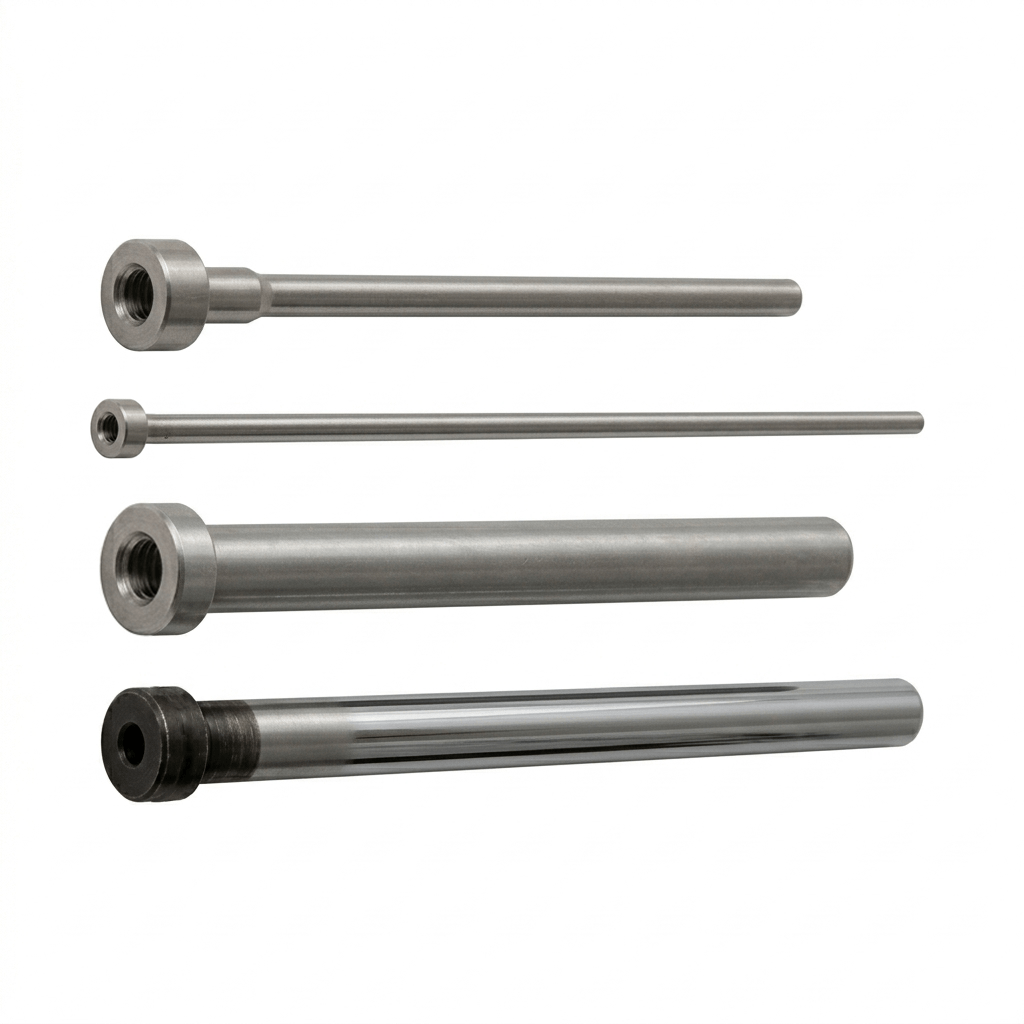
Understanding the technical specs of these two materials is one thing, but seeing how they stack up against each other in a production environment is where the choice becomes clear. While SKD61 is undoubtedly the “premium” option, the “better” choice depends entirely on your specific operational requirements.
To help you visualize the gap between these two materials, here is a direct comparison across the most critical performance metrics:
| Feature | 65Mn (Manganese Steel) | SKD61 (Tool Steel) |
| Heat Resistance | Low (Softens above 200°C) | Excellent (Stable up to 600°C) |
| Surface Hardness | HRC 50–55 | HV 900+ (After Nitriding) |
| Core Toughness | Moderate | High (Vacuum Quenched) |
| Primary Use | Standard Plastic Injection | Die-Casting & Precision Molding |
| Service Life | Short to Medium | Long / High-Volume |
| Unit Cost | Very Economical | Higher Investment |
The Critical Divergence: Heat & Friction
The most significant difference lies in thermal stability. In a high-speed injection mold, the friction between the ejector pin and the mold base generates localized heat. Because 65Mn lacks alloying elements like Chromium and Vanadium, it loses its “temper” quickly. Once the pin softens, it begins to gall (scuff) or flash, leading to defective parts.
In contrast, SKD61 is born for this heat. The addition of Molybdenum and Vanadium allows it to stay rigid and slick even when the mold is running “white-hot.” Furthermore, the nitrided surface of an SKD61 pin acts as a self-lubricating barrier, significantly reducing friction and wear compared to the raw surface of a 65Mn pin.
From Cost to Value
When comparing these two, you aren’t just comparing the price of a piece of metal; you are comparing operational risk.
- 65Mn is a “disposable” solution—perfect for low-pressure, low-temp jobs where you expect to retire the mold sooner rather than later.
- SKD61 is a “structural” solution—designed for engineers who cannot afford to stop a multi-million dollar production line just to replace a $5 pin.
Decision Guide: Which Pin Should You Choose?
Selecting between SKD61 and 65Mn isn’t about finding the “best” material overall, but rather the “right” material for your specific project goals. Using the wrong pin can lead to either wasted budget or, more dangerously, unexpected mechanical failure.
To make the right choice, evaluate your project based on these three professional criteria:
1. The “Heat Factor” of Your Application
The temperature of your molding process is the ultimate deal-breaker.
- Choose 65Mn if you are working with low-temperature plastics (like PP or PE) in a standard cooling environment where the mold temperature stays well below $200^\circ\text{C}$.
- Choose SKD61 for any Die-Casting (Aluminum, Magnesium, or Zinc) or high-performance engineering plastics (like PEEK or PPS) that require elevated mold temperatures.
2. Production Volume and Tooling Life
Consider how many cycles the mold is expected to complete.
- Low-Volume (Under 50,000 cycles): If you are building a prototype mold or a tool for a limited-edition product, 65Mn provides the most logical ROI. There is no need to over-engineer a tool that will soon be decommissioned.
- High-Volume (Over 100,000+ cycles): For mass production, the durability of SKD61 is mandatory. The cost of “down-time” (the labor required to disassemble a mold to replace a worn-out 65Mn pin) will quickly surpass the initial savings of the cheaper material.
3. Precision and Complexity
- Simple Parts: For large, thick-walled plastic parts where slight friction marks aren’t a concern, 65Mn is perfectly adequate.
- Precision Components: If your part has tight tolerances or requires a flawless aesthetic finish, SKD61 is the safer bet. Its nitrided surface ensures smooth, consistent ejection without the “sticking” or “galling” that can ruin high-end parts.
Summary Strategy
A common industry “best practice” is to use 65Mn for trial molds and initial sampling, then switch to SKD61 for the final production tool. This allows you to keep development costs low while ensuring that your final manufacturing line is as robust and reliable as possible.
Conclusion
The choice between SKD61 and 65Mn ejector pins ultimately comes down to the demands of your production environment.
- 65Mn remains a valuable asset for the industry due to its low cost and reliable performance in “cold” and low-pressure molding. It is the king of short-run efficiency.
- SKD61, however, is the backbone of modern, high-speed, and high-temperature manufacturing. Its ability to withstand extreme heat and resist wear makes it an indispensable choice for die-casting and high-volume injection molding.
By matching the material to your mold’s lifecycle and thermal requirements, you can optimize your tool’s performance, minimize maintenance-related downtime, and ultimately achieve a higher quality finished product.