7 Non-Standard Ball Cage Types GUNRI Manufactures for Custom Applications
A few weeks ago, a mold engineer from Germany emailed me with a drawing attached. “Can you make this?” he asked. The part was a ball cage, but it didn’t match any standard MISUMI or HASCO catalog page I knew.
I looked at the drawing, then scrolled through photos of parts we have produced over the last five years. Most of what we make is non-standard. That is exactly what many buyers need — they just do not know what is possible.
Here are 7 non-standard ball cage types we have manufactured for customers — think of them as a starting point, not a complete list. If your design looks like one of these, we can likely make it. If not, send us your drawing — we produce custom designs that most factories cannot.
Quick overview: ① Stepped Recess Cylindrical ② Ring Plate Ball Retainer ③ Flanged Long Cylindrical ④ Strip Plate Retainer ⑤ Slotted Thin-Wall ⑥ Full Dense Matrix ⑦ Single-Row Partition
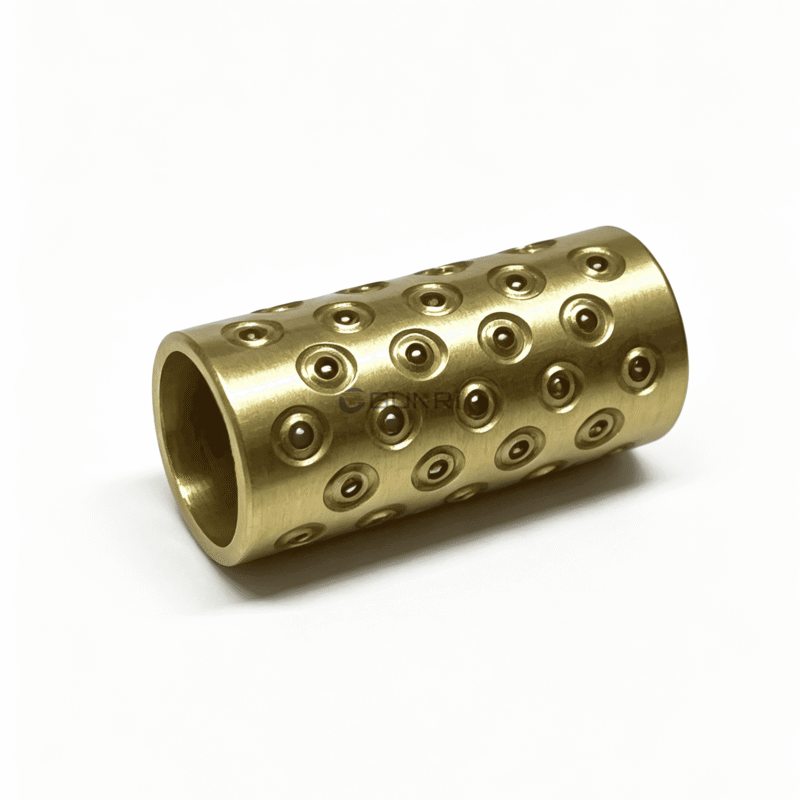
1. Stepped Recess Cylindrical Ball Cage
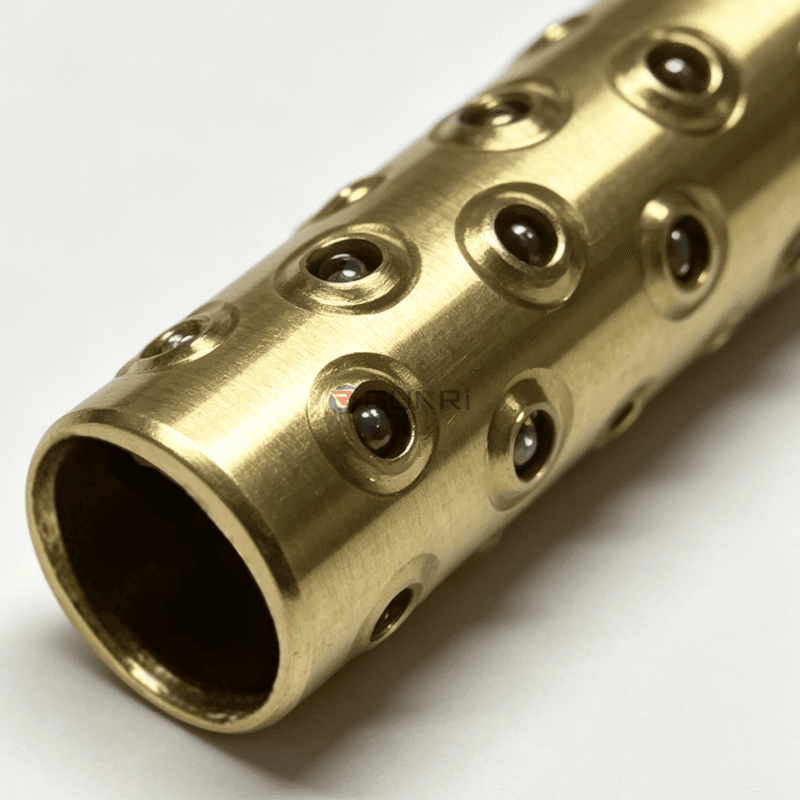
This is the most common non-standard type we produce. Instead of a simple dimple, each ball sits in a stepped counterbore — a two-level recess that locks the ball in place. The outer wall forms a raised collar around each ball, creating an enclosure that prevents the ball from escaping even under high-speed reciprocation or shock load.
 ball cage front view” class=”wp-image-16076″/>
 ball cage side view showing counterbore detail” class=”wp-image-16077″/>
The ball sits deeper in this design, so it handles higher loads and lasts longer. I have seen this pocket style on IKO miniature stroke rotary bushing (STSI) retainers, though we use it on full-size die set components as well. The stepped recess geometry also allows extremely compact designs — we produce these with inner diameters down to 2.0 mm and steel balls as small as 0.6 mm, far below what standard MISUMI or HASCO catalogs offer.
Best for: cylindrical ball guides under radial bidirectional load — die guide pins, precision linear bushings, and high-speed stamping dies where ball retention is critical.
2. Ring Plate Ball Retainer
Not every ball cage is a cylinder. When you need rotary motion or axial thrust support, a ring-shaped retainer is the right choice. Balls are arranged around the circumference of a flat ring, each sitting in a shallow single-dimple pocket. This increases surface contact with the mating part and lowers sliding resistance in the axial direction.
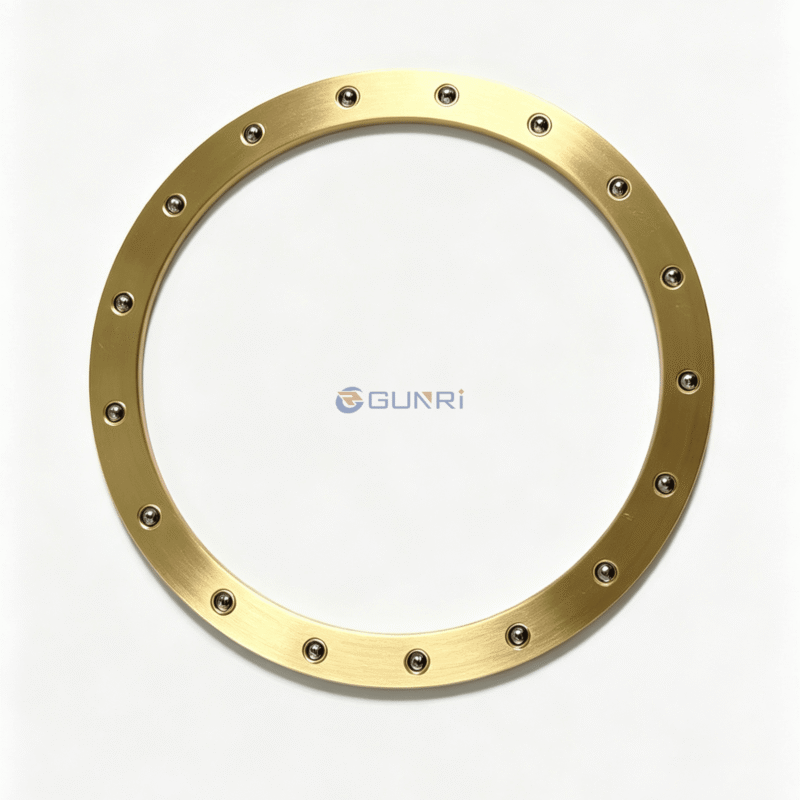
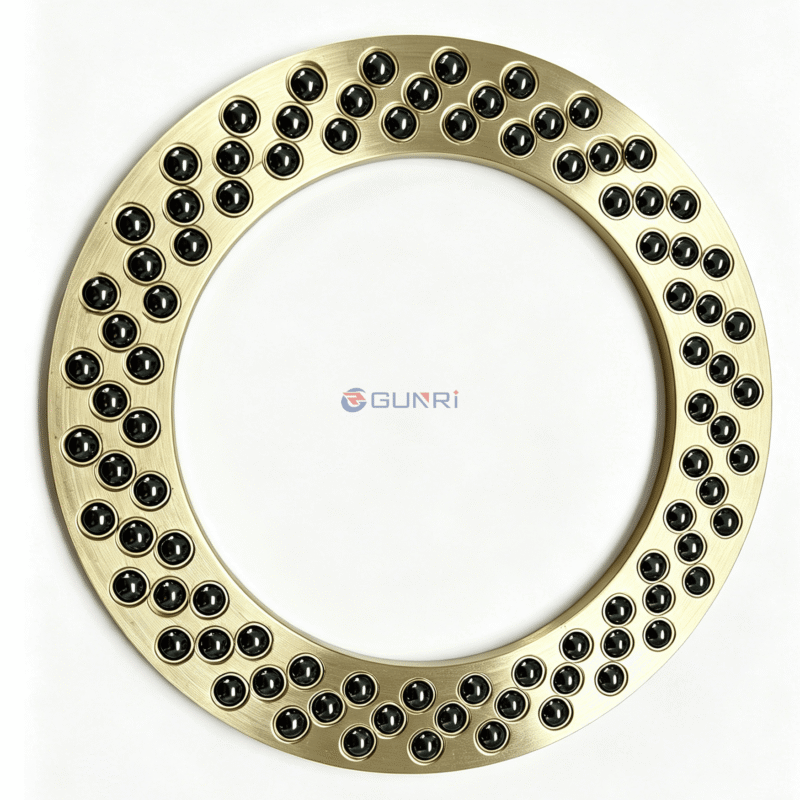
Best for: thrust washers, rotary index tables, mold plate alignment rings, and applications where axial thrust is the primary load direction.
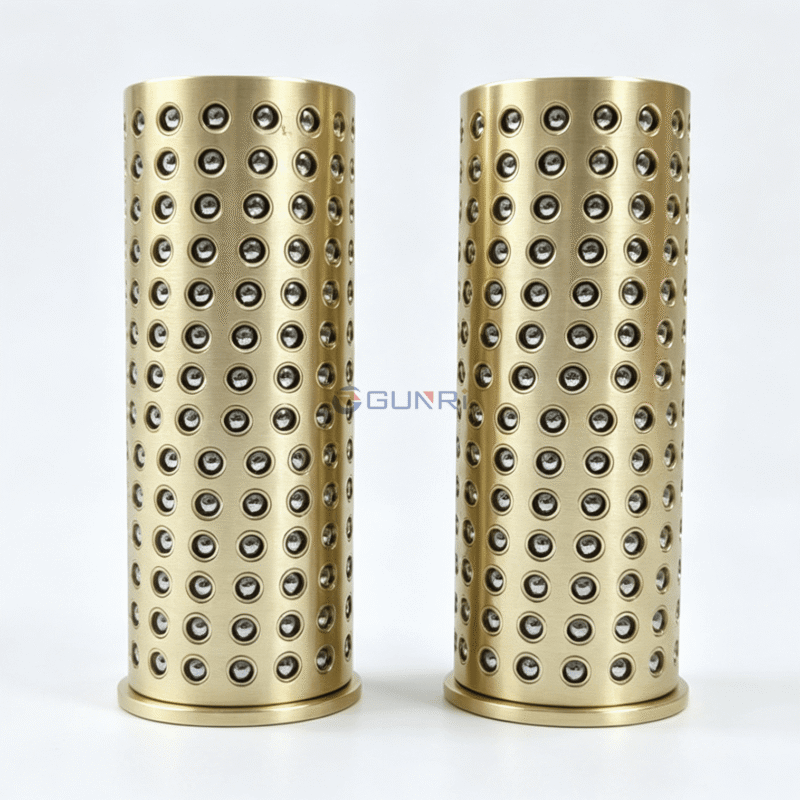
3. Flanged Long Cylindrical Ball Cage
When your die set needs a long stroke and high rigidity, this is the design I recommend. The cylinder is fully enclosed with no cutouts, and an integrated flange base provides positive location in the mold plate. Balls are arranged in a dense grid pattern across the entire barrel wall — no empty zones — giving the highest ball density per unit area for better load distribution and longer service life. We have manufactured these with outer diameters up to 400 mm, suitable for large press die sets and heavy machinery.
 ball cage with base” class=”wp-image-16080″/>
Best for: large die sets with long guide pillars, heavy stamping dies, and applications demanding maximum rigidity and load capacity.
4. Strip Plate Ball Retainer
Sometimes you do not need a full cylinder — just a linear strip of rolling elements. The strip plate is a flat bar with balls arranged in single or multiple rows along the length. You can specify the number of rows, ball spacing, strip thickness, and overall dimensions to match your guide rail or mold base exactly. It is surprisingly versatile for such a simple form. We produce these in brass, POM, or aluminum depending on the application requirements.
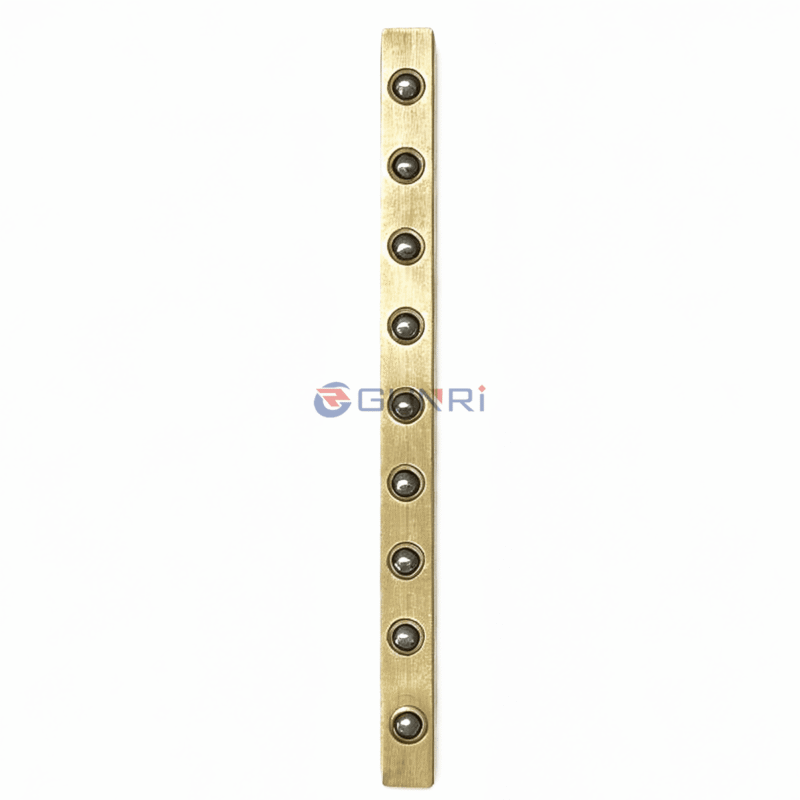
Best for: linear guide rails, mold base slide alignment, ejector plate guidance, and applications where a full bushing is unnecessary.
5. Slotted Thin-Wall Ball Cage
We start with a standard cylinder and machine large cutout windows through the wall. The barrel is split into upper and lower load bands — the center section stays open. Three benefits: less raw material usage, visual inspection of ball wear without disassembly, and reduced weight for high-speed or automation applications. The shortest we produce is 8 mm, making this design practical for compact automation modules and precision instruments.
The trade-off is lower structural rigidity. Not ideal for heavy-duty long-stroke dies, but for light to medium loads, it is a smart, cost-effective option.
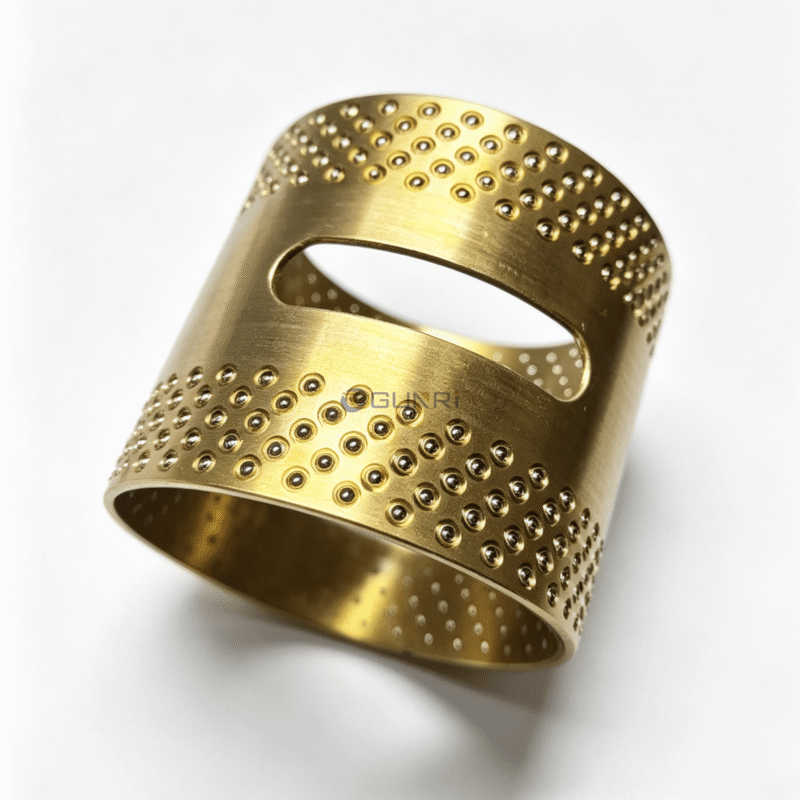 ball cage” class=”wp-image-16082″/>
Best for: compact precision molds, automated guided systems, and equipment where maintenance access is limited.
6. Full Dense Matrix Ball Cage
If you want the highest possible ball density, this is the design for you. The entire barrel wall is covered with balls in a uniform grid — no gaps, no empty bands, no windows. More balls means each individual ball carries less load, extending wear life and reducing guide system clearance. Ball density is fully customizable — we adjust the grid pattern, ball diameter, and spacing to match your specific load and stroke requirements, not limited to any fixed configuration. For high-precision stamping dies running at high frequencies, this design consistently delivers the longest service intervals.
The downside is cost — more material and more machining time. But if your application demands maximum precision and uptime, the investment pays for itself.
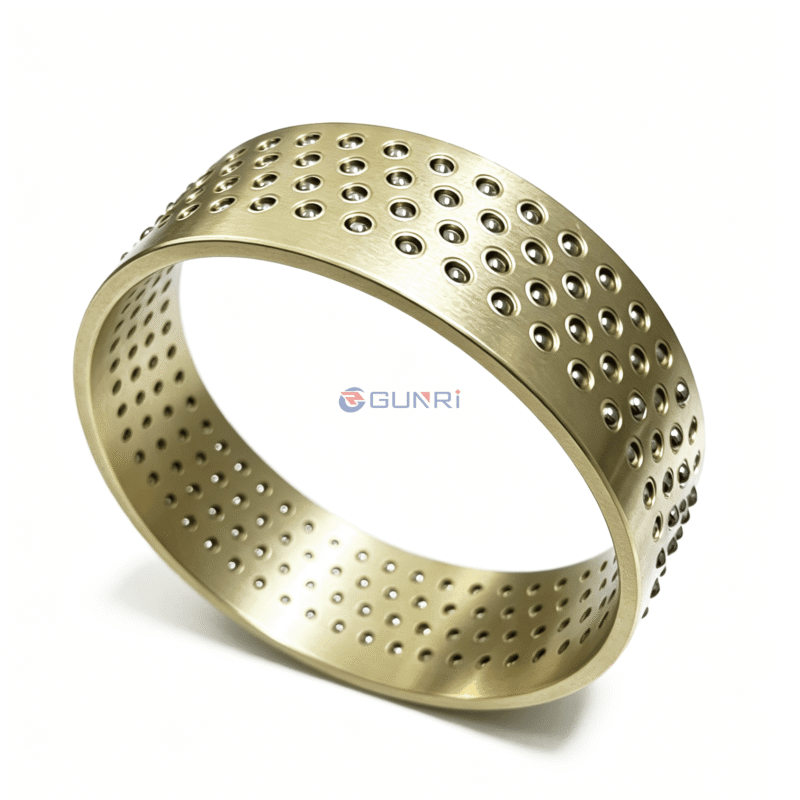 ball cage barrel view” class=”wp-image-16083″/>
Best for: high-precision stamping dies, long-stroke heavy-duty tooling, and high-frequency automated production equipment.
7. Single-Row Partition Ball Cage
This layout arranges balls in separate vertical columns with solid brass gaps between the rows. Those gaps act as lubricant reservoirs — grease stays in the channels and feeds the contact surfaces gradually, reducing re-lubrication frequency.
The separated columns also handle eccentric loading better. If the load shifts to one side, only the corresponding ball column takes the force — the other columns stay aligned, preventing the cage from skewing under off-center loads.
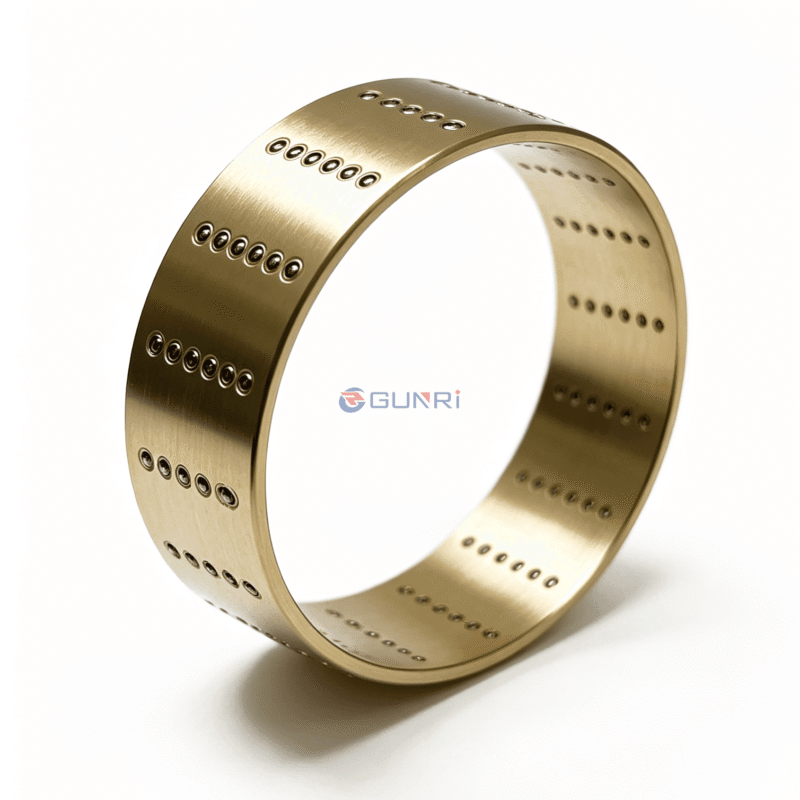 ball cage” class=”wp-image-16084″/>
Best for: injection molds, light-to-medium load linear modules, and applications where off-center loading or extended maintenance intervals matter.
Have a Non-Standard Ball Cage Design? Send Us Your Drawing
These 7 types cover many of the non-standard requests we see, but they are just examples — not a limitation. Every month, we get a drawing that does not fit any of these categories. That is not a problem — we make those too.
If you have a ball cage design in mind, send us the drawing or specifications. We can manufacture it with your choice of ball size, density, and retention method. Unsure what design suits your application? Start with our custom ball cage guide page for a detailed overview.
We typically respond within 24 hours with a quote and feasibility assessment.