What’s the difference between FC250 cast iron and copper alloy oil-free slide plates?
A maintenance engineer I worked with had a recurring problem. The oil-free slide plates on a 600-ton press’s die change carriage were wearing out every eight months. The existing plates were copper alloy with graphite plugs. He asked me: “If I switch to cast iron FC250, will I get longer life, or am I creating a new problem?” The answer is not straightforward — and it depends on load, speed, environment, and mating surface condition.
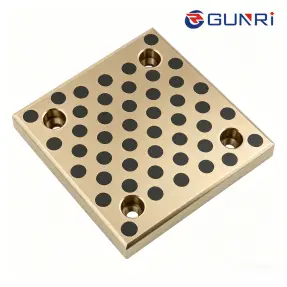
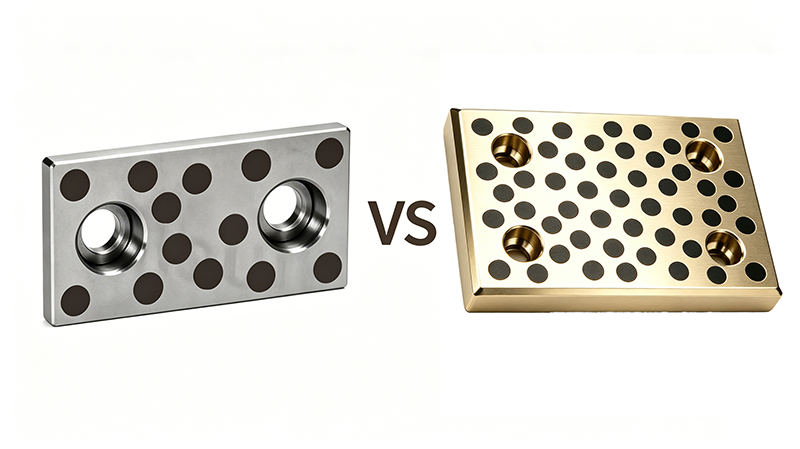
Cast iron FC250 oil-free slide plates offer higher compressive strength and lower cost per unit, while copper alloy oil-free slide plates provide superior corrosion resistance, better emergency dry-run behavior, and gentler wear on the mating steel surface. Neither is universally “better” — the right choice depends on whether your application prioritizes load capacity and budget (FC250) or corrosion resistance and mating surface protection (copper alloy).
Here is how the two materials compare across the properties that actually matter in die and machinery applications.
The Material Difference — Cast Iron FC250 vs. Copper Alloy at the Microstructure Level
FC250 is a JIS-grade gray cast iron, equivalent to DIN GG25 or ASTM A48 Class 40B. Its microstructure consists of flake graphite dispersed in a pearlitic matrix. The graphite flakes act as a natural solid lubricant — that is why gray iron has inherently better dry-sliding properties than steel. But those same graphite flakes also act as stress risers, which makes FC250 brittle in tension and vulnerable to edge chipping under impact loading.
Copper alloy oil-free slide plates are typically made from high-strength aluminum bronze (C95400, C95500) or high-tensile brass (CuZn25Al5). These materials have a fully metallic matrix with no flake graphite content — the lubrication comes entirely from embedded graphite plugs. The matrix itself is tougher and more ductile than FC250, meaning it can handle edge loading, misalignment, and occasional impact without cracking
Load Capacity — Where Cast Iron Excels and Where It Falls Short
FC250 cast iron has a compressive strength of approximately 600–800 MPa, which is significantly higher than most copper alloys (C95400 aluminum bronze has a compressive strength of about 450–550 MPa). For purely compressive, low-speed sliding applications — such as static support pads, locating blocks, or guide rails under steady uniform load — FC250 can carry more weight per square millimeter than a copper alloy plate of the same thickness.
However, FC250’s tensile strength is only about 250–350 MPa, and its elongation at break is essentially zero — it does not stretch or deform before fracturing. Copper alloys typically have 15–25% elongation. This matters in applications where the slide plate might experience bending stress, edge loading from misaligned gibs, or shock during press operation. In those scenarios, the copper alloy’s toughness prevents catastrophic fracture where FC250 might snap.
Wear and Friction Behavior — Why the Graphite Plug Matrix Matters
Both FC250 and copper alloy oil-free slide plates rely on embedded graphite plugs for lubrication. The graphite transfers to the mating steel surface and forms a low-friction transfer film. The coefficient of friction for both materials, when properly lubricated by the graphite film, falls in the range of 0.06–0.15 .
The key difference is what happens when the graphite film is depleted or the slide plate is operating at the edge of its PV limit. In a copper alloy plate, the underlying metal is relatively soft (typically 160–220 HB) and will wear gradually, polishing the mating surface rather than gouging it. In FC250, the iron matrix is harder (200–250 HB for FC250 with a pearlitic matrix) and contains hard carbide phases. If the graphite film breaks down, FC250 can begin to abrade the mating steel rail, accelerating wear on both surfaces.
I have seen this firsthand in a stamping plant where FC250 plates on a die set ran dry after a graphite plug fell out. Within 500 cycles, the mating steel guide surface was scored to a depth of 0.15 mm. Replacing the FC250 plates with copper alloy stopped the scoring immediately, even though the wear rate on the plate itself increased slightly.
Corrosion Resistance — The Biggest Differentiator
This is where the choice becomes clear for many applications. Cast iron FC250 is highly susceptible to rust. In any environment with moisture, coolant splash, or high humidity — typical in stamping dies, injection molds, and hydraulic systems — FC250 slide plates will develop surface corrosion if not protected by oil or grease .
Since oil-free slide plates are specified precisely because the user wants to eliminate lubricants, the irony is clear: an oil-free FC250 plate in a damp environment will rust. Surface rust increases friction, generates abrasive particles, and accelerates wear on both the plate and the mating surface.
Copper alloys, by contrast, naturally resist corrosion. Aluminum bronze forms a protective oxide layer that is stable in water, mild acids, and alkaline solutions. For applications in food processing, marine environments, chemical plants, or anywhere coolant is present, copper alloy is the only reliable choice between these two materials.
Temperature Limits — Both Handle Heat, but Differently
Both FC250 and copper alloy oil-free plates can operate at temperatures up to approximately 300°C when using standard graphite plugs. At higher temperatures, graphite begins to oxidize and lose its lubricating properties regardless of the base metal.
The difference lies in how the base metal behaves under thermal cycling. FC250, with its flake graphite structure, has good dimensional stability — it does not warp or grow significantly with repeated heating and cooling. Copper alloys have a higher coefficient of thermal expansion (approximately 18–20 µm/m·°C for bronze vs. 10–12 µm/m·°C for cast iron). This means a 500 mm long copper alloy slide plate will expand roughly 0.4 mm more than an FC250 plate over a 100°C temperature swing. In tight gib clearance applications, that extra expansion can cause binding .
Cost and Weight Considerations
FC250 cast iron oil-free slide plates are typically 30–50% less expensive than copper alloy equivalents, based on raw material cost alone. Cast iron is cheaper per kilogram, has lower machining costs (the graphite flakes act as chip breakers), and is widely available globally.
FC250 is also approximately 15% lighter than copper alloy (density ~7.2 g/cm³ vs. ~8.5–8.8 g/cm³ for bronze). For large plates, this weight difference simplifies handling during installation.
However, if the application requires corrosion resistance or if a failed FC250 plate could damage the expensive mating steel component, the total cost of ownership may favor the copper alloy despite the higher initial price.
Application Guide — Which Oil-Free Slide Plate to Choose
| Application Condition | Recommended Material | Reason |
|---|---|---|
| Dry environment, high static load, low sliding speed | FC250 Cast Iron | Higher compressive strength, lower cost, graphite flakes add backup lubrication |
| Coolant or moisture present | Copper Alloy | Corrosion resistance — FC250 will rust |
| Mating surface is precision ground steel | Copper Alloy | Softer material polishes rather than scores the steel |
| Edge loading or misalignment possible | Copper Alloy | Toughness prevents cracking where FC250 may chip |
| Food processing or pharmaceutical | Copper Alloy | Non-toxic, corrosion resistant, FDA-compatible graphite available |
| High-temperature application (>200°C) | Either | Both similar — check graphite plug grade for temperature rating |
| Cost-sensitive, low-risk application | FC250 Cast Iron | 30–50% cost savings if corrosion and scoring risks are acceptable |
| Thin plates (<10 mm) | Copper Alloy | FC250 brittleness increases risk of fracture in thin sections |
If you are evaluating oil-free slide plates for a specific application, browse our range at oilless wear plate with graphite to find both FC250 and copper alloy options with matching hole patterns and standard sizes.
Frequently Asked Questions
Can FC250 cast iron oil-free slide plates be used in food processing equipment?
Not recommended. FC250 will rust in washdown environments, and rust particles are a contamination risk. Copper alloy is the standard choice for food-grade applications.
Which material lasts longer in a dry stamping die environment?
If the die is well-maintained and alignment is true, FC250 often lasts longer because of its higher wear resistance. If the die experiences misalignment or coolant splash, copper alloy lasts longer because it resists corrosion and handles edge loading better.
Is FC250 interchangeable with copper alloy slide plates in existing pockets?
Only if the pocket depth accommodates the same thickness and the mounting holes align. The dimensional difference from thermal expansion should also be verified for high-temperature applications. Always check the supplier’s standard size chart before switching materials.
Do FC250 plates need any surface treatment for corrosion protection?
Some manufacturers apply a phosphate or black oxide coating for mild corrosion protection. These coatings wear off during operation. For permanent corrosion resistance, copper alloy is the correct material choice.
Which material is quieter in operation — FC250 or copper alloy?
Copper alloy is generally quieter. The softer matrix dampens vibration more effectively than cast iron, which can transmit higher-frequency noise in sliding applications.