Why LVDT Sensors Need Special Ball Retainers
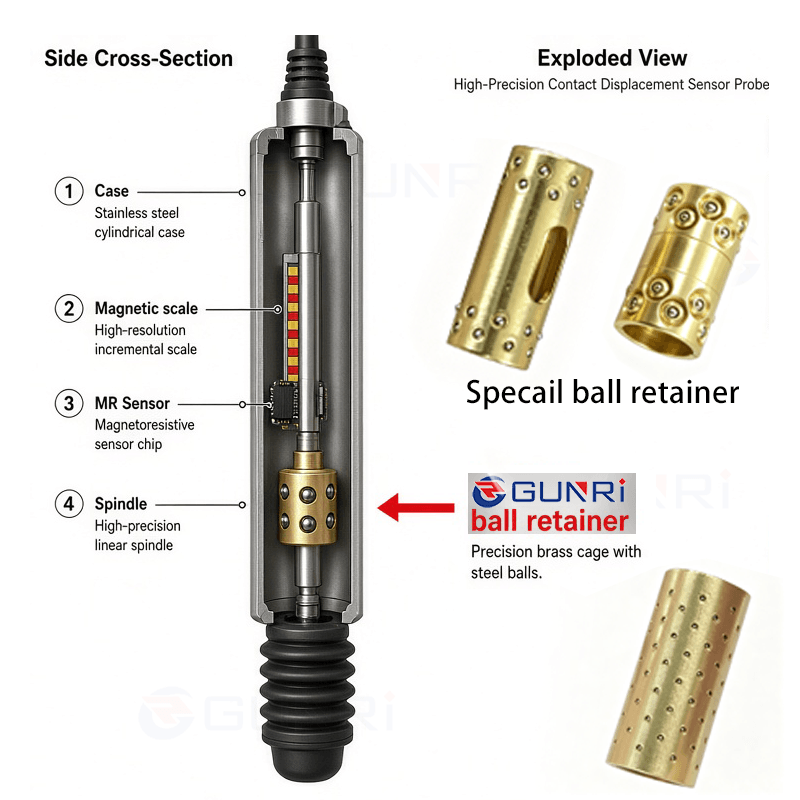
Every maintenance engineer has seen this: a captive LVDT gauge head is installed, calibrated, and within weeks the readings drift, the signal gets noisy, or the plunger starts sticking. The first suspect is usually the electronics, the cable, or the signal conditioner. But in many injection-mold and industrial-gaging installations, the real culprit is a tiny mechanical part inside the probe: the ball retainer (also called a ball cage). A generic off-the-shelf cage cannot survive the vibration, thermal cycling, side loads, and contamination of a production environment. That is why LVDT sensors — especially captive contact-probe style heads — need purpose-built special ball retainers.
LVDT sensors need special ball retainers because the retainer is not a passive spacer. It is the only rolling interface between the plunger spindle and the sensor housing. It sets radial play, controls friction, determines side-load tolerance, and decides whether the probe still repeats after millions of strokes. A generic die-set cage or commodity polymer cage has the wrong geometry, wrong ball size, wrong material, and wrong retention for a miniature LVDT head. The result is hysteresis, cage walk, ball clustering, brinelled plunger tracks, and signal non-linearity — even when the LVDT core and coil are perfectly fine.
What the Ball Retainer Actually Does Inside an LVDT
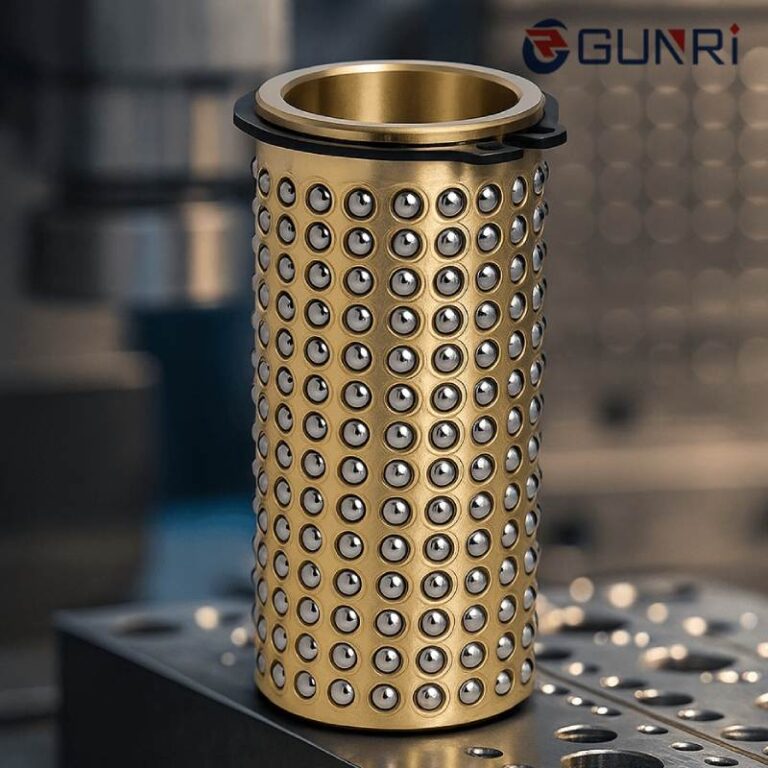
In a captive LVDT or contact displacement probe, the ball retainer is a thin sleeve — usually brass — with precision miniature balls sitting in machined pockets. The balls roll between the hardened spindle OD and the honed housing bore. The retainer performs four jobs that directly affect measurement quality:
- Keeps balls equally spaced around the spindle, preventing clustering and uneven load distribution.
- Sets radial play or light preload between shaft and housing — near-zero play without stick-slip is the target for sub-micron repeatability.
- Allows axial travel with minimal friction; point contact on each ball keeps rolling resistance low even under spring preload.
- Prevents balls from falling out, brinelling one track, or walking out of position during long stroke cycles.
Point contact is the point. Each ball touches the shaft and bore on a tiny area, so friction stays low. That is why ultra-precision LVDT gauge heads (LBB-style) quote sub-micron repeatability: the plunger is rolling, not sliding. A sliding bushing will not survive tens of millions of full-stroke cycles without a friction rise that the LVDT core reads as noise.
Why Generic Retainers Fail in LVDT Service
Wrong geometry — die-set cages are not probe cages
A standard MISUMI / FIBRO / DANLY ball cage is built for die guide posts. Diameters are large, balls are large, lengths are long, and the duty is high-SPM stamping. You can sometimes cut one down, but you should not expect it to drop into a Ø6 mm pencil probe. A special LVDT retainer means miniature ID (often under 10 mm), short length relative to die cages, dense miniature ball fields, and optional slotting aligned to a housing window.
Ball crowding and uneven load
When a retainer deforms under repeated side loads from mold misalignment, balls cluster instead of staying equally spaced. Load concentrates on a few balls, creating brinelling indentations on the hardened plunger shaft. Radial clearance grows, the plunger wobbles, and that lateral movement translates directly into variable core-to-coil air gaps — producing noisy, non-repeatable LVDT output.
Polymer creep and thermal drift
Commodity nylon or POM cages are quiet and cheap, but they creep, absorb moisture, and drift with temperature. Next to an LVDT coil or MR magnetic scale calibrated in microns, that drift is unacceptable. Near hot mold platens, polymer retainers soften and warp pockets, causing ball binding and increased plunger friction.
Magnetic interference
Steel cages add ferromagnetic mass right next to the LVDT coil or MR sensor region. That distorts the magnetic field the sensor depends on. Brass is non-magnetic and is the default special retainer material for LVDT and magnetic-scale probe architectures.
No ball retention method
Cheap cages rely on loose ball fit. When the probe tip is pulled for service or the plunger is withdrawn, balls fall out. A proper special retainer uses staked / coined pockets, a slight brass interference, or a dedicated clip — consistent across every ball.
| Property | Generic / die-set cage | Special LVDT ball retainer | Impact on measurement |
|---|---|---|---|
| Typical ID | Large (die post size) | Under 10 mm, miniature | Fits pencil-probe and gauge-head housings |
| Material | Steel, nylon, POM | Brass / bronze (non-magnetic) | No magnetic distortion near LVDT coil |
| Ball grade | Commercial large balls | G10–G25 miniature bearing balls | Sub-micron repeatability, low friction |
| Ball rows | Often single row | Two circumferential rows (classic gauge-head layout) | Stable pitch under side load |
| Pocket tolerance | Loose commercial | Precision-machined, even pitch | No periodic runout from uneven spacing |
| Retention | Loose fit | Staked / coined / interference | Balls stay captive during service |
| Temperature range | 80–100 °C (polymer) | 140–180 °C (brass) | Withstands radiant heat from mold platens |
| Slot option | Usually none | Longitudinal slot for pin / scale window | Clears housing features without weakening ball rows |
Core Engineering Features of a Special LVDT Retainer
Geometry matched to your spindle and bore
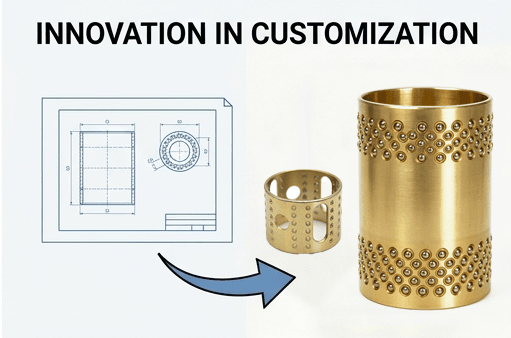
Do not start from a catalog ID. Start from the two steel diameters you already have: spindle OD and case bore ID. The cage is the remaining sandwich. Ball diameter Dw ≈ (bore ID − spindle OD) / 2, minus intended clearance or plus intended preload interference. Cage length must support at least two ball circuits along the axis — too short causes moment under side load; too long causes cage walk and extra mass. A competent retainer shop can reverse the ball size from spindle OD, housing ID, and stroke. If you need a custom brass ball retainer for your LVDT probe, GUNRI manufactures custom ball cages and non-standard guide bushings to exact spindle/bore specifications. Guessing Dw from a photo is how you get a cage that rattles or will not assemble.
Brass material — the default for metrology heads
Brass and bronze are preferred inside LVDT probes for three reasons: they machine to stable precision pockets, they are non-magnetic (critical next to LVDT coils and MR scales), and they do not smear on a chrome shaft the way soft polymer can. Aluminum is sometimes used for large cages but raises galvanic and pocket-strength concerns at miniature sizes. Steel cages are usually avoided because of magnetic disturbance. Polymer cages are rare in metrology heads due to creep, moisture swell, and temperature drift.
Slot vs. closed barrel
This is the feature most people miss, and the one that makes a cage “special.” A closed barrel gives maximum hoop stiffness and best roundness — use when the cage is a pure rolling bushing. A longitudinal slot clears a drive pin, a magnetic-scale window, or a grease/inspection opening, and lets the brass flex slightly so a dense ball field can be assembled onto the spindle. Slot width and clocking relative to ball rows matter: a slot that cuts through a pocket row leaves a weak ball and a stress riser. Put the slot on a land between circuits.
Fit, preload, and runout
Probe makers do not want a sloppy linear bearing. They want a hand-honed match: balls seated so radial play is near zero without a stick-slip spike at mid-stroke. Three regimes:
- Clearance fit — easy assembly, some radial play. Fine for long-stroke industrial LVDTs where the core is not a metrology plunger.
- Line-to-line / light preload — the target for contact gauge heads. Repeatability in the 0.1 µm class needs this. Assembly is by careful hone and ball grade, not by forcing a too-large cage.
- Heavy preload — raises friction and shortens life. Almost never correct in a spring-extend probe; the return spring already loads the tip.
Specify the assembled radial play you will accept — for example, “no perceptible shake, sliding force under X cN on a dry shaft.” A drawing that only shows cage OD/ID without ball grade and assembled play is incomplete.
Life, contamination, and environment
Contact heads fail from grit in the bellows, dry running after the lube film is gone, and side load from a misaligned stand — not from “soft brass.” Still, the cage must be specified for the duty:
- Cycle count: full-stroke life in the 10⁷–10⁸ range needs consistent pocket retention and balls that do not brinell the plunger.
- Lubrication: thin instrument oil or dry film; never heavy die grease that migrates onto the scale or coil.
- Temperature: brass expands more than steel. On a wide-temp LVDT, check that preload does not lock at cold or rattle at hot. Miniature cages are matched as a set with a given shaft lot.
- Magnetics: keep ferromagnetic mass off the scale/coil region. Brass cage, steel balls only where they already are.
Field Symptoms of a Failing Ball Retainer
When the special retainer degrades, you will usually see these signs before total sensor failure:
- Reading drift even at static plunger position
- Higher-than-expected plunger friction when manually actuated
- Spiky electrical noise on a stable displacement signal
- Increasing radial free-play when wiggling the plunger by hand
- Intermittent sticking at specific stroke positions
- Periodic runout repeating at ball-circuit frequency
Mistakes That Kill LVDT Repeatability
- Copying a die-set cage ID onto a probe drawing
- One ball row on a long plunger (pitch instability under side load)
- Polymer cage next to a scale calibrated in microns
- Slot cutting through a pocket row
- No ball-retention method — balls leave when the tip is pulled for service
- Heavy grease in a sealed bellows (stiction after a weekend)
- Poor hardness matching so the chrome plunger brinells
Frequently Asked Questions
Q: Can I replace a damaged special ball retainer with an off-the-shelf bearing cage?
A: Generally no. LVDT linear ball bearings use miniature-diameter balls with ultra-tight pocket tolerances and non-magnetic brass construction. A mismatched cage introduces radial play, binding, or magnetic interference. You risk losing sensor linearity specifications even if physical assembly appears correct.
Q: Does a free-core LVDT also require a special ball retainer?
A: No. Free-core LVDT designs have no mechanical plunger-bearing assembly; the core floats contact-free inside the coil bore. Ball retainer requirements apply only to captive-guided or spring-loaded contact-probe-style LVDTs used for position measurement.
Q: What material makes the best special ball retainer for LVDT gauge heads?
A: Brass or bronze machined retainers are the default. They are non-magnetic (critical near LVDT coils), machine to stable precision pockets, and do not smear on chrome shafts. Reinforced high-temperature polymer may work for cooler, lower-precision locations, but avoid standard nylon or POM for metrology-grade heads.
Q: Will better lubrication fix performance issues caused by a worn-out ball retainer?
A: Lubrication can reduce short-term friction symptoms, but it cannot reverse permanent pocket deformation, cracked retainer walls, ball-pocket tolerance drift, or brinelled plunger tracks. Once the retainer structure is compromised, replacement is necessary.
Q: How do I specify a special retainer for my LVDT probe?
A: Send: spindle OD and tolerance (material, hardness, coating), housing bore ID and tolerance (hone spec), stroke, available cage length, ball diameter if known (or “calculate from fit”), slot requirements (yes/no, width, clocking), assembled radial play or preload target, expected cycles and temperature, magnetic constraints, and a photo or section of the current probe. A competent retainer manufacturer can reverse-engineer the ball field from these.
Need a Special LVDT Ball Retainer?
Send us your spindle OD, housing bore ID, stroke, and slot requirements — we will reverse-engineer the ball field and quote within 24 hours. Explore our custom ball cage capabilities →
Looking for ball cages for LVDT gage heads and guided displacement probes? See our application page →