Ejector Sleeves for Injection Molds and Die Casting Dies (SKD61 / SKH51)
Description
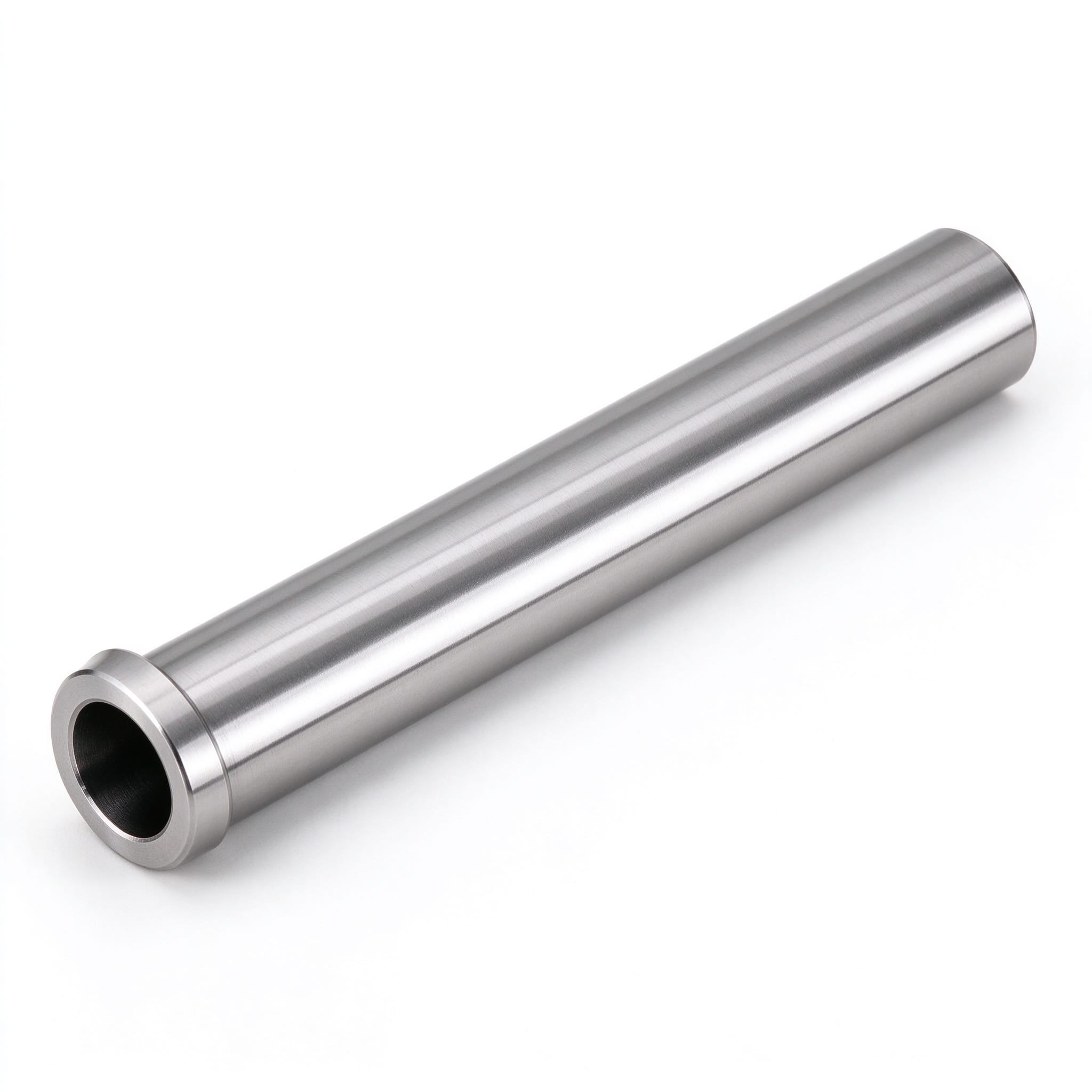
An ejector sleeve is a hollow ejector that pushes a molded part off a core pin. Instead of pressing on the part with a pin tip, the sleeve slides over the pin and applies force in a ring around the boss, so the part leaves the core without a dimple, without white stress marks and without a bent pin. GUNRI manufactures ejector sleeves in SKD61 and SKH51 to coaxiality of 0.01 mm and length up to 1,000 mm, in standard metric sizes and to customer drawings.
What an ejector sleeve actually does
The sleeve has three jobs at once, and a sleeve that is bought only on outside diameter will usually fail on one of them.
- Guide the ejector pin. The bore keeps the pin straight over its full stroke, which stops the pin from buckling on a long, thin core.
- Spread the ejection force. Force is applied as a ring around the boss rather than as a point load at the center, so thin-walled bosses do not crack and the surface does not show a pin mark.
- Protect the core pin. In a mold with a deep core pin, the sleeve acts as a wear liner: the pin rubs on the sleeve bore instead of on the mold plate, and the cheaper part wears out first.
That third function is why sleeves are common in high-cycle molds even when the part geometry does not strictly need one.
Ejector sleeve or ejector pin? Use this rule
| Situation | Use | Why |
| Flat or gently curved surface, mark is acceptable | Ejector pin | Cheapest, simplest, no bore to align |
| Boss or cylindrical feature around a core pin | Ejector sleeve | Force goes around the wall, not into it |
| Thin-wall boss, cosmetic surface, visible part | Ejector sleeve | Ring mark instead of a dimple; no stress whitening |
| Long, slender core pin that tends to bend | Ejector sleeve | The sleeve supports the pin along its length |
| High-cycle mold, pin wear is the maintenance cost | Ejector sleeve | The sleeve is the sacrificial wear part |
| Very small ejection area, tight pitch between features | Ejector pin | No room for sleeve wall thickness |
A practical shortcut: if the feature you are ejecting is a hole with a pin through it, you want a sleeve. If it is a surface, you want a pin.
Full comparison: ejector sleeve vs ejector pin
Material selection: SKD61 or SKH51
Both grades are in our standard range, and the choice is driven by failure mode rather than by hardness alone.
| SKD61 | SKH51 | |
| Type | 5% Cr hot-work tool steel (AISI H13 equivalent) | High-speed steel (AISI M2 equivalent) |
| Inner hardness | 38–42 HRC | 59–61 HRC |
| Surface | Nitrided, HV900 and above | Through-hardened |
| Max length | 1,000 mm | 300 mm |
| Coaxiality | 0.06 mm | 0.01 mm |
| Achievable precision | 0.01 mm | 0.005 mm |
| Best for | Die casting, high-temperature resins, thermal cycling, impact | Abrasive-filled resins, thin-wall precision, glass-filled PA/PBT |
| Watch out for | Lower core hardness — do not use where abrasive wear dominates | Less tolerant of thermal shock and impact; not the first choice for die casting |
Rule of thumb: if the die sees repeated thermal cycling or any molten metal, start with SKD61. If the sleeve is wearing out from glass fiber rather than from heat, go to SKH51. If you need both wear resistance and thermal tolerance, that is a conversation about coating rather than about grade.
Ejector sleeves in die casting dies
Die casting is a different duty from injection molding, and a sleeve that works in a plastic mold can fail quickly in an aluminum die. The differences that matter:
- Melt temperature. Aluminum is poured around 650–700 °C, against 200–300 °C for most engineering resins. The sleeve runs far hotter and the nitrided case matters more than the core hardness.
- Thermal cycling every shot. The sleeve expands and contracts against a pin that is at a different temperature. Clearance that is correct cold can be wrong hot.
- Molten metal adhesion. Aluminum and zinc solder to steel. A polished bore and a nitrided surface reduce it; a rough bore accelerates it.
- No draft on the ejected feature. Wash and flash find any positive clearance, so the ID band has to be specified for the operating temperature, not for room temperature.
Our die casting sleeves are specified in SKD61 with a nitrided case above HV900 and a polished bore, up to 1,000 mm in length.
Ejector sleeves for die casting: selection, clearance and failure modes
Specifications
SKD61 ejector sleeves
| Parameter | Value |
| Material | SKD61 (JIS), AISI H13 equivalent |
| Inner hardness | 38–42 HRC |
| Surface hardness | HV900 and above (nitrided) |
| Length | up to 1,000 mm |
| Coaxiality | 0.06 mm |
| Achievable precision | 0.01 mm |
| Bore finish | Ground and polished |
| Size range | Standard metric sizes and to customer drawing — contact us for the current size range |
SKH51 ejector sleeves
| Parameter | Value |
| Material | SKH51 (JIS), AISI M2 equivalent |
| Hardness | 59–61 HRC |
| Length | 300 mm standard |
| Coaxiality | 0.01 mm |
| Achievable precision | 0.005 mm |
| Size range | Standard metric sizes and to customer drawing — contact us for the current size range |
Both grades: custom ID, OD, shoulder geometry and head form to drawing. Tolerances tighter than the table are quoted case by case.
How to size an ejector sleeve
Four dimensions decide whether a sleeve works, and only two of them appear on a catalog page.
- ID — must clear the core pin at operating temperature. Specify the pin’s actual measured diameter, not the nominal.
- OD — set by the wall thickness you need for the ejection load and by the counterbore it sits in.
- Length — the sleeve should support the pin over the full ejection stroke, not just at rest.
- Head / shoulder form — determines how the sleeve is retained in the ejector plate. This is where most cross-reference errors happen.
Send us the pin diameter, the boss diameter, the stroke and your die temperature, and we will return an ID/OD/length proposal with the shoulder form drawn.
DME, HASCO and MISUMI equivalents
Most enquiries we receive are not for a new design — they are for a replacement of a catalog part that is out of stock, over-priced or on a long lead time. We match on ID, OD, length and head geometry, then confirm the equivalent in writing before production.
Send the reference part number (DME, HASCO, MISUMI or your own drawing number) and we will reply with the equivalent and the differences, if any.
Manufacturing and quality control
GUNRI (Dongguan Gunri Precision Hardware Co., Ltd.) has produced precision die and mold components since 2006 from a 10,000 m² manufacturing base, and holds ISO 9001:2015 and IATF 16949:2016 certification. Products are exported to more than 30 countries, and we produce OEM parts for foreign brands.
Ejector sleeves are ground after heat treatment, then the bore is polished. Coaxiality is checked on the finished part, not on the blank. Inspection records are supplied with the shipment on request.
FAQ
What is the difference between an ejector sleeve and an ejector pin?
An ejector pin pushes the part directly and leaves a small witness mark. An ejector sleeve is a hollow tube that slides over a core pin, so ejection force is distributed around the boss and the mark is a clean ring instead of a dimple.
Should I choose SKD61 or SKH51?
SKD61 is the general choice: inner hardness 38–42 HRC with a nitrided surface above HV900, giving a tough core that resists cracking under repeated impact. SKH51 runs 59–61 HRC and suits thin-wall or abrasive-filled resins where wear dominates.
What tolerance and coaxiality can you hold?
SKH51 sleeves: precision to 0.005 mm and coaxiality 0.01 mm, length 300 mm. SKD61 sleeves: precision to 0.01 mm and coaxiality 0.06 mm, length up to 1,000 mm.
Can you supply DME, HASCO or MISUMI equivalent sleeves?
Yes. Send the reference part number or drawing and we will match ID, OD, length and shoulder geometry, then confirm the equivalent before production.
Can ejector sleeves be used in die casting dies?
Yes, but the working conditions differ from injection molds. Die casting adds higher melt temperature, thermal cycling and aluminum or zinc adhesion, which is why SKD61 with a nitrided surface is normally specified.
What is the typical lead time and minimum order?
Standard sizes are quoted individually and custom sleeves are produced to drawing. Share your sizes and quantity and we will confirm lead time and minimum order for that specification.
Get a sleeve specification, not just a part number
Send us your sizes, drawing or reference part number. We reply with a specification and price, and flag any tolerance we cannot hold before you order.
Last updated: November 2026