Why Are Ejector Pins Important? The Backbone of Injection Molding
Six months ago, a friend of mine who runs a mold shop in Shenzhen called me frustrated. He had just landed a big contract for an automotive connector — 500,000 parts per year. The mold cost $18,000. The first production run failed. Parts came out with surface marks, inconsistent dimensions, and a 15% scrap rate. His customer was threatening to pull the contract.
He asked me: “Are my ejector pins causing this?”
Yes — and this is the single most common source of quality problems in injection molding that gets misdiagnosed as a process issue. Ejector pins are the only component responsible for removing the finished part from the mold. If they are undersized, poorly finished, wrongly placed, or worn beyond tolerance, they will deform the part, mark the surface, or fail to eject altogether. No amount of temperature adjustment, pressure tuning, or cooling time optimization can fix a problem that originates at the pin-part interface. The mold design and pin specification must be correct before any process parameter matters.
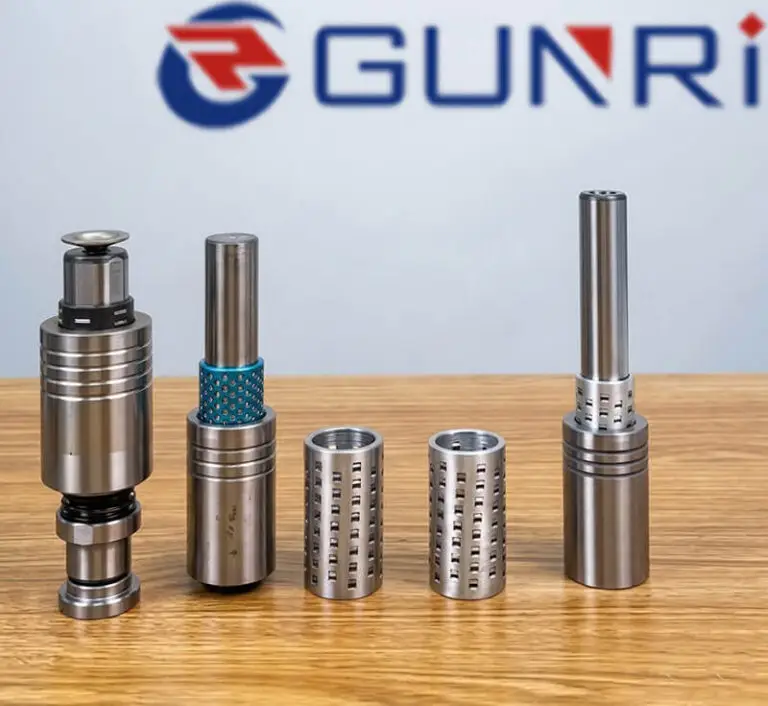
In his case, the mold used standard straight pins at the minimum recommended diameter for the part weight. The pins were flexing under load, applying uneven force to the part surface. We replaced them with shouldered ejector pins one size up, nitrided, with f6 fit clearance. Scrap rate dropped below 1%. The contract was saved.
Why One Bad Pin Can Shut Down a Whole Mold
Unlike cooling channels or gate locations — where you have multiple parallel paths — ejection has no redundancy. Each cavity relies on its assigned pins. If one pin sticks, that cavity stops. If three pins in a 4-cavity mold gall simultaneously, the mold comes out of the press. There is no backup ejection system.
This is why pin specification is a reliability decision, not a cost decision. The three variables that determine pin lifespan are material grade, surface treatment, and fit class:
- Material. SKD61 (H13) hot-work steel with nitriding handles 900-1100 HV surface hardness and maintains core toughness up to 540°C. For higher-temperature engineering plastics (PA66, PPS), switch to SKH51 (M2) high-speed steel — it retains hardness up to 600°C. Our SKD61 vs 65Mn comparison explains material trade-offs in detail.
- Surface treatment. Nitriding adds 0.01-0.03mm of wear-resistant case. TiN coating reduces friction by approximately 40%, directly reducing ejection force and galling risk.
- Fit class. At 100°C operating temperature, a 6mm pin expands by 0.007mm. A zero-clearance fit guarantees seizure. The standard f6 fit (0.008-0.022mm clearance) accommodates this expansion while keeping the pin centered. We cover this topic in depth in Should Ejector Pins Be Tight?.
How Ejector Pin Quality Affects Part Quality
The pin contacts the part at the moment it is hottest and least rigid. Any imperfection in the pin — surface roughness, edge burr, out-of-roundness — transfers directly to the part surface. The table below shows the relationship between pin quality and common part defects:
| Pin Issue | Part Defect | Root Cause |
|---|---|---|
| Rough surface finish (Ra > 1.6 μm) | Drag marks, streaks | Insufficient grinding/polishing |
| Poor concentricity (> 0.05mm) | Uneven ejection, warpage | Pin bends under load, applies uneven force |
| Worn tip (rounding > 0.01mm) | Surface indentations | Reduced contact area increases local pressure |
| Wrong fit (too tight) | Sticking, galling, downtime | Insufficient clearance for thermal expansion |
| Wrong fit (too loose) | Flash around pin head | Melt penetrates clearance gap |
How to Specify Ejector Pins Correctly
Here is a practical decision framework based on part geometry and production requirements:
Step 1: Determine pin type by part geometry. Flat surfaces need standard round pins. Thin ribs need flat pins. Deep cores need shouldered pins. Hollow sections need ejector sleeves. Each type exists because no single geometry works for every case.
Step 2: Select diameter by part weight and projected area. A common rule is 1 pin per 20-30 cm² of projected area, with minimum diameter of 1.0mm. Below 1.0mm, pins buckle under normal ejection forces of 50-100 MPa. Our ejector pin size guide provides diameter recommendations by material and part weight.
Step 3: Choose material and surface treatment based on mold temperature. Under 120°C mold temperature, SKD61 nitrided is sufficient. Above 120°C, or for glass-filled materials, upgrade to SKH51 with TiN coating.
Step 4: Specify fit class based on pin diameter and mold temperature. For most applications, start with f6. For large-diameter pins (> 10mm) or high-temperature molds, use e7 to provide additional clearance for expansion.
The ejector pins and sleeves category on our site organizes all standard options by type, material, and size with configurable dimensions for each.
Why Cheaping Out on Pins Costs More
I have seen mold shops replace pins every 30,000 cycles because they bought untreated SKD61 at $1.50 per pin. A nitrided SKD61 pin costs $3-4. A TiN-coated SKH51 pin costs $8-12. Yet the nitrided pin lasts 100,000-150,000 cycles, and the TiN-coated pin lasts 300,000-500,000 cycles.
The math is simple: buying the cheap pin saves $2-3 upfront but costs $50-200 in additional replacement labor and downtime per pin over the mold’s lifetime. For a 16-cavity mold running 500,000 cycles per year, that difference adds up to $3,000-8,000 annually in hidden costs.
Frequently Asked Questions
Q: What is the most common ejector pin mistake I see in new molds?
A: Using straight pins where shouldered pins are needed. Deep cavities generate ejection forces that straight pins cannot resist without buckling. If your mold has a core depth greater than 3x the pin diameter, specify shouldered pins.
Q: Can I tell if a pin is failing before it breaks?
A: Yes. Measure tip diameter every 50,000 cycles. A reduction of 0.01mm or more means the pin is wearing. Also check for bright spots on the pin shaft — those indicate localized galling contact.
Q: Does pin placement affect part quality as much as pin quality?
A: At least as much. A perfectly made pin placed at the wrong location will still mark the part. Pins should be placed at the stiffest features of the part — ribs, bosses, and corners — not in the middle of flat unsupported areas.
Q: Should I use lubricant on ejector pins?
A: Yes — high-temperature grease applied to the pin shank reduces startup friction and prevents galling during the first few cycles after mold startup. Avoid over-lubricating, as excess grease can contaminate the mold cavity.