How Does a Ball Lock Punch Work and What Are Its Main Advantages?
Picture a stamping line mid-run. A punch has started leaving a burr, and the operator walks over, depresses a little steel ball, slides the old punch out, and snaps a fresh one in. No wrenches, no crane, no teardown. The die never leaves the press. That short ritual is the whole story of ball lock punches — and it’s why so many die shops reach for them when changeover speed matters more than hold-down work.
What Is a Ball Lock Punch and How Does the Locking Mechanism Work?
Keep the answer simple: ball lock punches snap in and out effortlessly through a spring-loaded steel ball that locks into a groove on the punch shank, and they’re built for heavy-duty die applications where ultra-tight, micron-level tolerances aren’t strictly required. No screwed threads, no press-fit seats, and no reason to pull the whole die assembly off the press just to swap one tool.
Here’s the anatomy of a ball lock punch system: the shank, a spring-loaded steel ball, and a matching groove (sometimes called a ball seat or recess) cut into the retainer. The spring presses the ball into that groove once the punch is seated. That wedge action is what holds the punch firmly against the backing surface during the stroke.
Installation is basically twist-and-lock. Line up the punch, push it in, and rotate until you feel the ball snap home. Dayton Lamina recommends deliberately misaligning the ball seat with the ball hole on the first insert so you can actually feel the snap, which confirms a proper lock. To release the punch, you press the ball to lift it out of the seat, and the punch slides free.
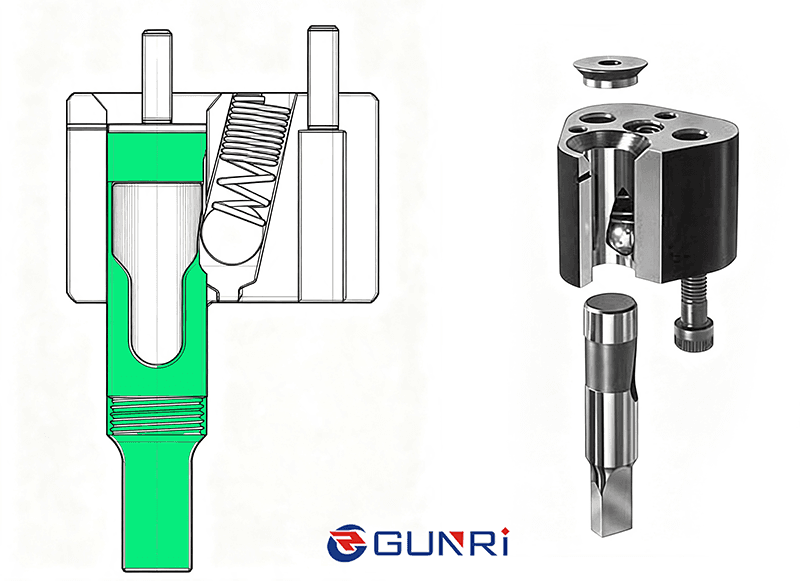
The wedge principle matters because it’s what allows quick release. A headed punch holds itself in place mechanically and needs fasteners; a ball lock punch relies on that single spring-loaded ball, which is exactly what makes it fast to change.
POP IN / POP OUT: Why Quick Change-Out Is the Main Selling Point
The headline benefit is best summarized as POP IN / POP OUT. You pull the worn punch, push in a fresh one, and you’re running again in seconds rather than in the time it takes to break down the tooling.
Compare that to a headed punch. Changing a headed punch means pulling bolts, lifting retainers out of the machine, and working down larger tools that can drag into hours and eat into repeated daily changeovers. With ball lock, the punch releases from the retainer and a replacement slots in place in a short burst of seconds. The die never gets pulled.
For a stamping operation running several punch stations, that speed adds up fast. Fast change-out is the reason shops that run frequent tool changes keep moving toward quick-change tooling in the first place.
The Industrial Pain Point It Solves: The Die Stays in the Press
The real pain point driving adoption is downtime. When you can reach a punch without lifting the die, you avoid the costly teardown and re-setup that normally stops production dead.
Dayton Progress puts it plainly: ball lock reduces die downtime because the punch locks into the retainer from beneath, and when it needs changing you pull it out without dismantling the whole punch-retainer system.
There’s a maintenance bonus hiding in here too. When the punch is pulled for regrinding (sharpening), the die set can stay mounted right on the press. You recondition the punch, pop it back, and retrim without ever breaking down the die. That’s real uptime recovered on every sharpening cycle, not just on changeovers.
Where Ball Lock Tips the Balance — and Where It Doesn’t (Honest Limits)
No tooling is universal, and ball lock punches come with honest trade-offs. They shine in medium and high-volume runs on soft to mild steel where changeover speed matters more than absolute precision. They are not the choice for applications that need micron-level, ultra-tight tolerances.
Dayton Lamina’s guidance spells out the limits clearly. Ball lock components suit high-volume, moderate-precision work. Thin materials needing tight die clearance can go beyond what these parts deliver, with a minimum recommended clearance around 0.0015″ per side. Thick or hard materials throw a lot of shock at impact and snap-through, which may exceed the retention capacity and cause punch pumping or ball breakage. High-speed presses above roughly 250 strokes per minute can trigger the same problems.
| Application factor | Ball lock suits it when… | Watch out when… |
|---|---|---|
| Material | Soft to mild steel | Thick, hard, or AHSS work |
| Precision | Moderate tolerances accepted | Tight die clearance / micron needs |
| Speed | Low to medium press SPM | High-speed over ~250 SPM |
| Changeover frequency | Frequent tool changes | Long, stable single runs |
So the honest guidance is this: pick ball lock when quick, frequent change-out and die-in-press maintenance win you the most hours. Choose tighter, more rigid tooling when the job demands absolute dimensional control on top of every stroke.
Frequently Asked Questions
How do you remove a ball lock punch from the retainer? Press the spring-loaded ball to lift it out of the groove, then slide the punch out of the retainer. Many retainers have a threaded release hole so you can use a small tool or set screw to depress the ball cleanly.
What’s the difference between a headed punch and a ball lock punch? A headed punch is held by its head and fasteners and usually needs more teardown to change. A ball lock punch is retained by a spring-loaded ball, so it slides in and out far faster and usually without removing the die from the press.
Can you regrind a ball lock punch without removing the die from the press? Yes. Because the punch releases independently from the retainer, you can pull, sharpen, and reinsert it while the die set stays mounted, which keeps downtime short on every maintenance cycle.
What are light-duty vs heavy-duty ball lock punch retainers? Light-duty retainers suit thin, mild materials up to roughly 0.125″ and softer hardness. Heavy-duty versions carry a bigger ball, handle thicker stock and higher stripping forces, and may use a booster spring in demanding cases.
When should you not use a ball lock punch? Avoid it when you need micron-level tolerances with tight die clearance, or when thick, hard materials and very high press speeds can cause punching issues like punch pumping or ball breakage.
If you’re weighing quick-change tooling for your stamping line, talk to us about the right retainer and punch combination for your material, your SPM, and your tolerance needs. As a professional contract manufacturer, we can machine the standard parts you need to your exact drawings and specs, whatever the batch size.