Can You Replace Ball Guide Posts with Needle Roller Guide Sets?
Yes. Converting a round ball guide assembly to the hexagonal needle roller type requires changing the complete set: guide post, guide bushing and rolling-element cage. The replacement must also suit the die’s mounting interfaces and working stroke. GUNRI is developing a separate round needle roller cage concept intended to retain the existing post and bushing.
Start with the assembly drawing. Two sets described as “25 mm guide posts” can have different bushing diameters, mounting shoulders and working lengths. The nominal post size is only one part of the replacement decision.
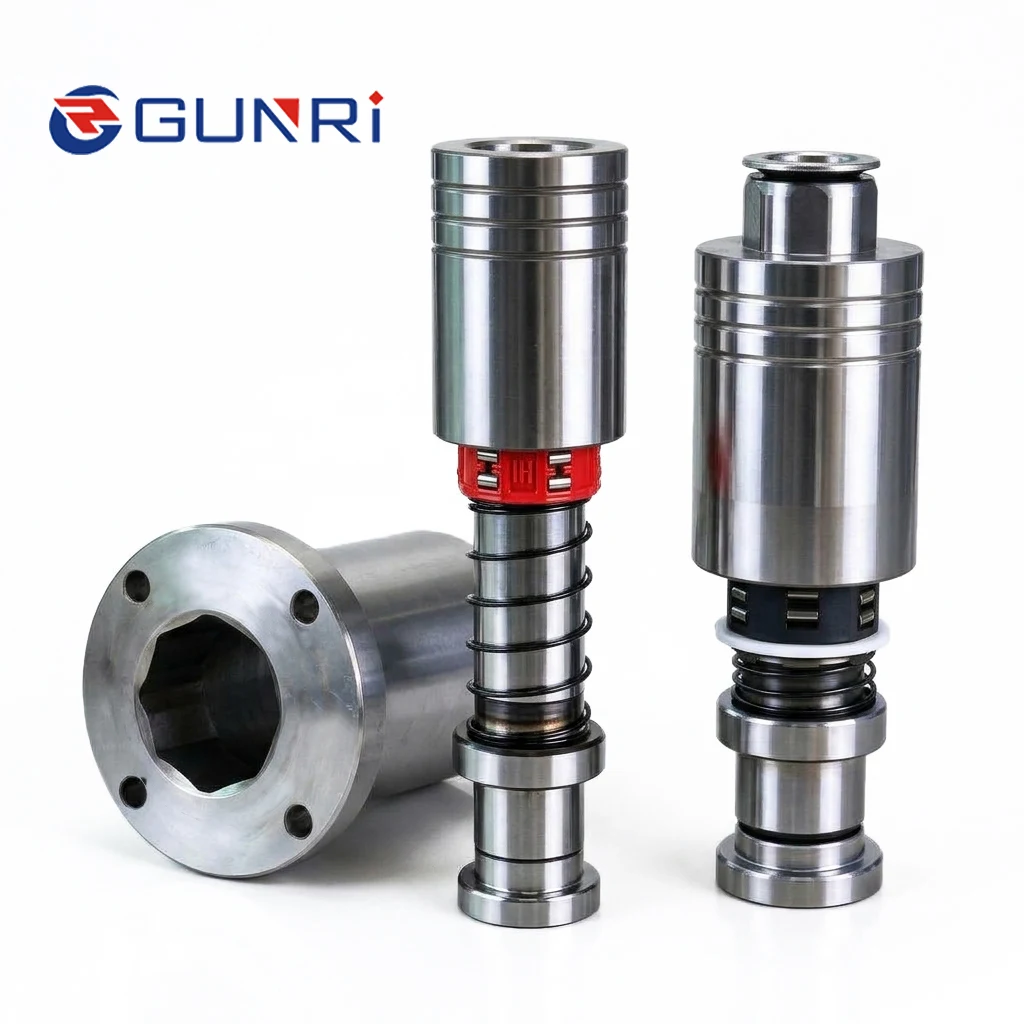
What actually changes when you switch?
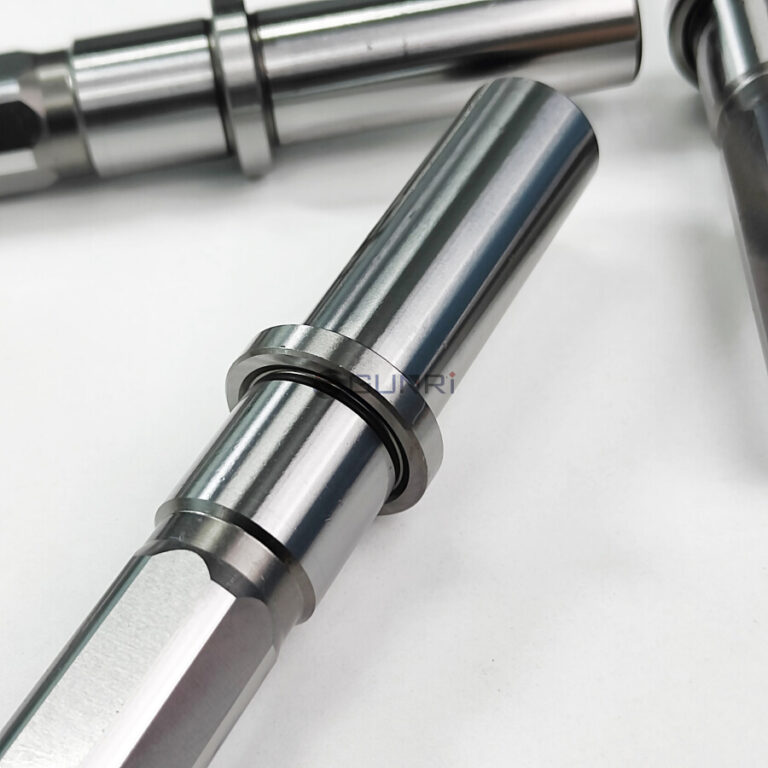
A conventional ball guide assembly uses a round guide post, a round internal guide surface in the bushing, and a cage carrying steel balls. In the hexagonal needle roller assembly shown here, the post’s working section has six flat raceways, and the needle roller cage has a matching six-sided arrangement. The bushing has corresponding internal flat raceways while its outside remains cylindrical. The illustrated post also has a cylindrical mounting section below its hexagonal working section.
For the round-to-hexagonal conversion, replace the guide post, guide bushing and cage together. The new needle roller cage needs the matching raceways on both parts. Changing only the post, only the bushing, or only the ball cage cannot create that hexagonal guide system.
The parts you may be able to retain are the die plates and their mounting features. That depends on the checks below. The round-cage concept described later in this article has a different development objective.
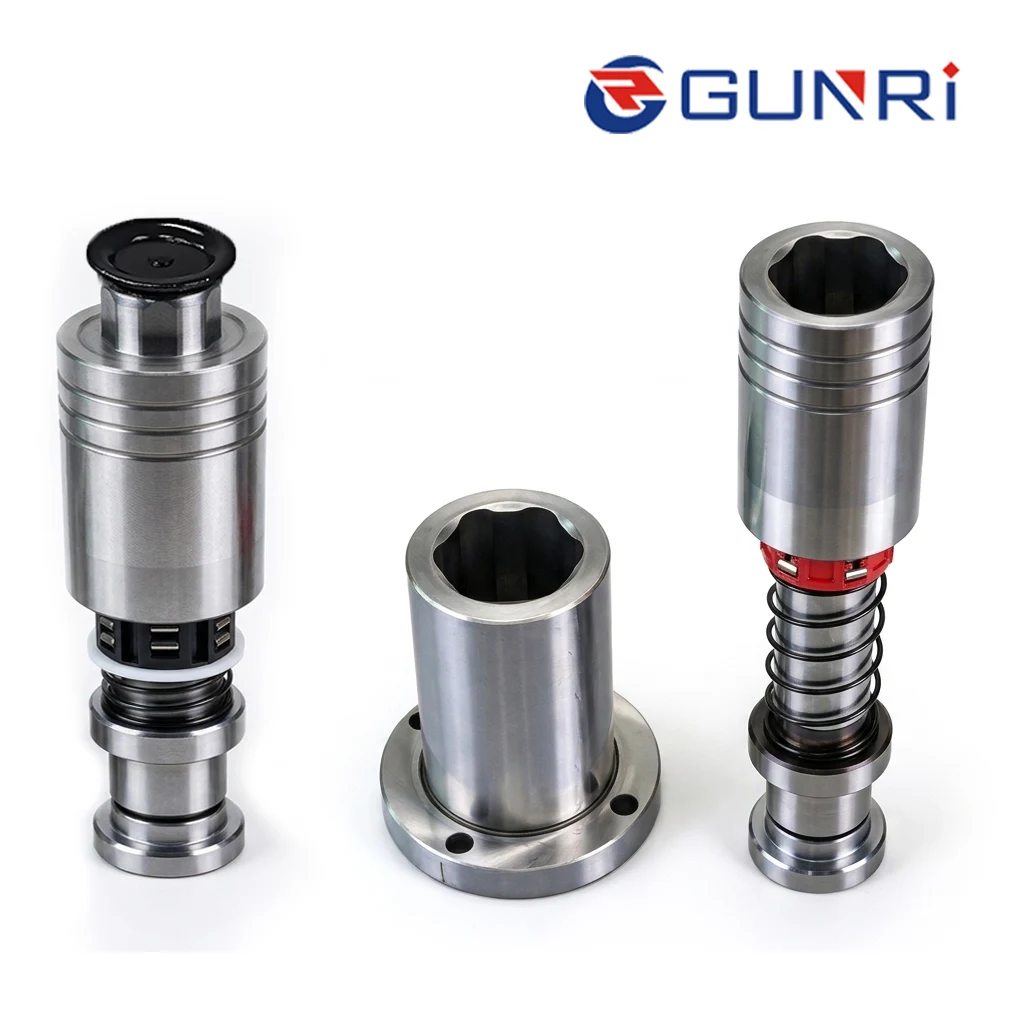
Will the complete set fit your existing die?
There are three possible outcomes when the old and proposed assembly drawings are compared.
| Outcome | What must be established | What it means for the project |
|---|---|---|
| Replacement using existing mounting features | Mounting dimensions and tolerances, retention method, working envelope and travel requirements are compatible. | The complete assembly may fit the existing plates, subject to installation checks and a die trial. |
| Custom assembly using existing mounting features | The standard set does not fit, but a feasible custom design can retain the existing interfaces. | A reviewed custom drawing is needed before the factory can confirm manufacture and price. |
| Conversion requiring plate changes | The proposed assembly needs different bores, seating faces, fastening positions or operating space. | The tool designer must assess plate rework and approve the revised installation. |
Ask which outcome applies before comparing unit prices. A lower component price can be outweighed by plate machining, reassembly and trial time.
Compare these eight items before ordering
Use both drawings side by side. Record measured dimensions separately when the only available reference is a worn assembly.
| Item | What to compare | Why it affects the conversion |
|---|---|---|
| Post mounting | Mounting diameter and tolerance, seating shoulder, engagement depth and retention method. | Matching the working portion of the post does not establish that its mounting end fits the plate. |
| Bushing installation | Outside diameter and tolerance, seating depth, flange or adhesive arrangement. | A larger bushing may require a larger plate bore. Different retention methods also change the installation. |
| Fastening clearance | Bolt locations, threads, washers, clamp space and tool access. | The assembly must be installable and removable in the actual die layout. |
| Open and closed positions | Relative post and bushing positions throughout the required travel. | Post length alone does not establish usable stroke or adequate engagement. |
| Retainer and stop arrangement | Retainer length, travel, stop position and spring arrangement where fitted. | Moving parts need clearance through the cycle and must satisfy the selected assembly’s retention requirements. |
| Alignment and orientation | Guide locations, mounting-face condition, post perpendicularity and any pairing or orientation marks. | The new set must follow the geometry required by its design. |
| Operating requirements | Required guidance, loading information, cycle rate and lubrication access. | Physical fit establishes only part of suitability for the application. |
| Maintenance access | Space to separate the die, inspect the rollers and remove the assembly. | A conversion also needs to work during tool servicing. |
For a guide design that requires continuous engagement, check the maximum open position explicitly. For a design that permits separation, confirm its re-entry requirements. Use the instructions for the selected assembly when making either check.
An example: the post size matches, but the bushing does not
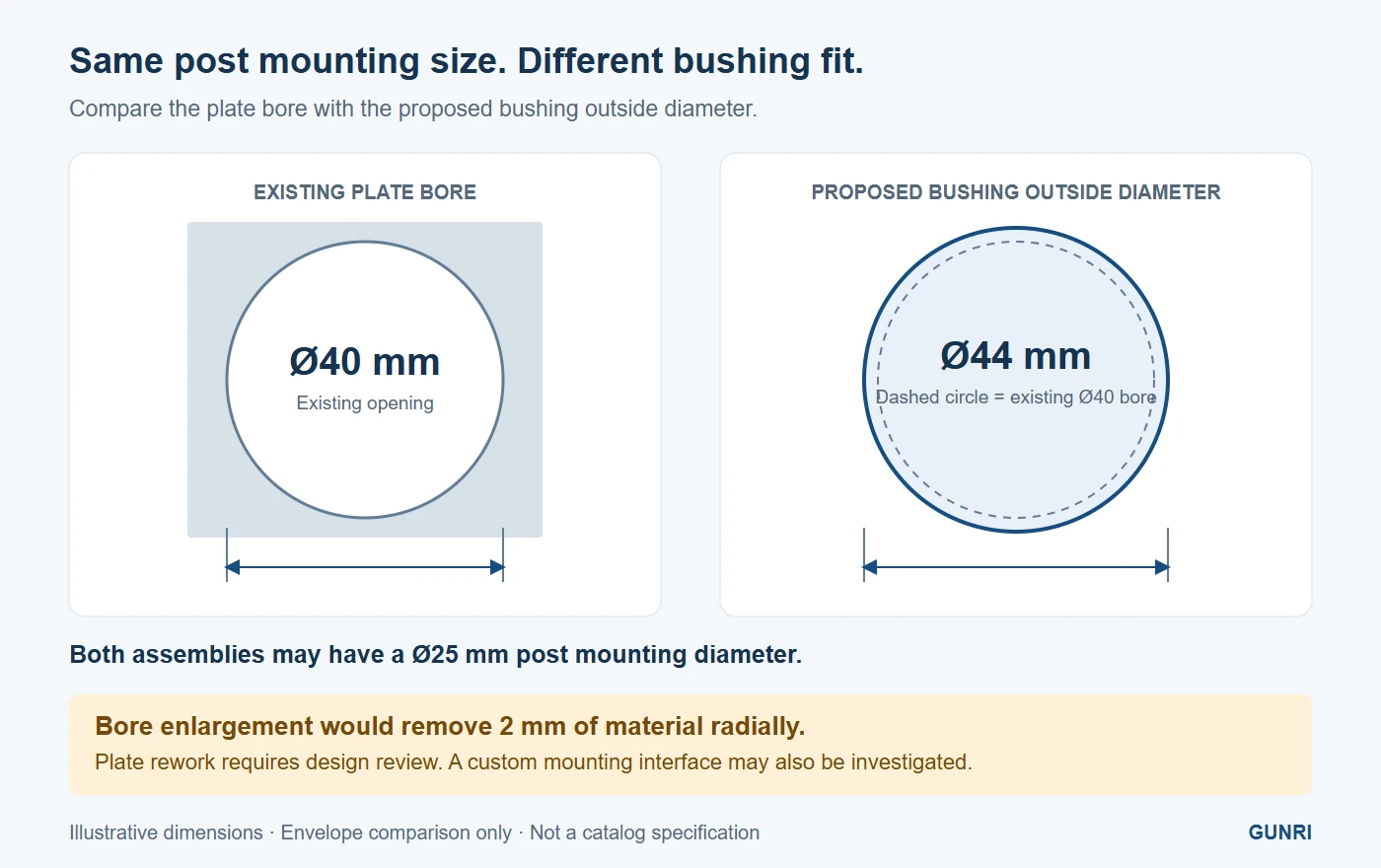
Consider an illustrative comparison in which the old and proposed sets both have a 25 mm post mounting diameter, but the old bushing is 40 mm outside diameter and the proposed one is 44 mm. These numbers illustrate the check and do not identify a particular catalog model.
The proposed bushing cannot fit the existing 40 mm bore. Increasing the bore to 44 mm would remove 2 mm of material radially. Before approving that change, the tool designer needs to assess the remaining material, nearby holes, bushing location and the required installation fit.
Two routes remain available for review: modify the plate for the proposed set, or investigate a custom assembly that retains the existing interface. A factory needs the relevant dimensions and requirements to assess the second route. A request for “a 25 mm replacement” leaves the controlling mismatch unresolved.
The circles in the diagram represent the plate bore and the bushing outside diameter. The hexagonal working surfaces are inside the guide assembly.
Is the conversion worth doing?
Needle rollers provide line contact at their raceways. In a suitable guide design, this can support higher guidance stiffness than a comparable ball arrangement. The size of the benefit depends on the complete assembly, its preload and the application.
Before committing to the conversion, identify what the existing tool needs to improve. Is there measured guide movement? Are the current guide surfaces worn? Is additional guidance stiffness required by a revised die design?
If the immediate symptom is burrs, inconsistent clearance or premature tool wear, establish the cause first. Cutting-edge condition, die alignment and plate deflection also deserve inspection. A guide conversion should address an identified requirement, with an agreed way to check the result.
Compare the complete cost of the conversion: guide sets, any plate work, installation, inspection and the production trial. Include a suitable replacement ball guide set in that comparison if the existing design previously met the production requirement.
GUNRI’s round needle roller cage development
GUNRI is also developing a round needle roller cage for existing round ball guide assemblies. The intended conversion keeps the round guide post and its bushing, replacing the steel-ball cage with a round needle roller cage. This approach is being developed to reduce the amount of the original guide assembly that needs to be changed.
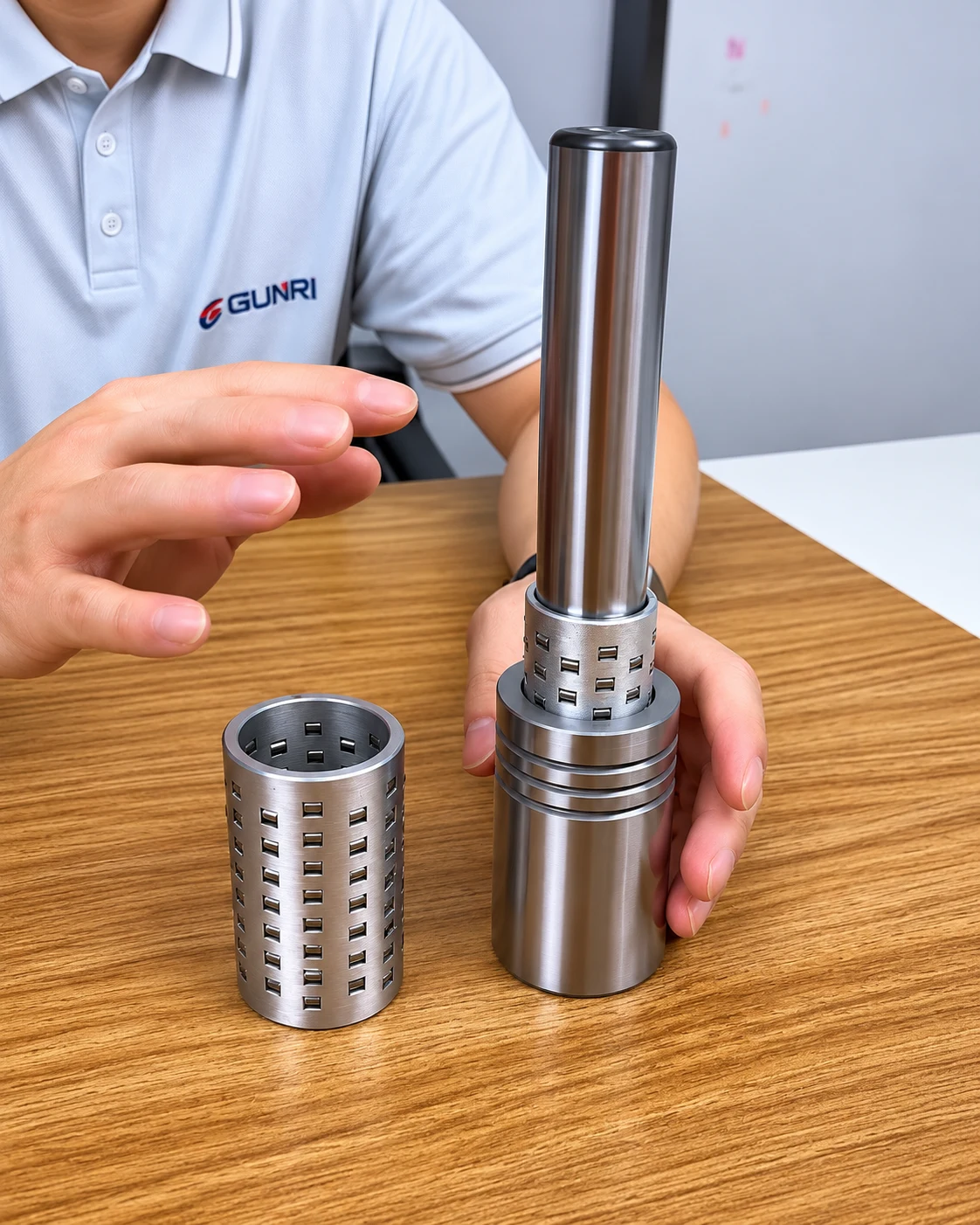
The photo shows GUNRI’s round needle roller cage development sample on a round guide post. The table below compares the intended component changes with the conventional hexagonal conversion discussed above.
| Component | Hexagonal needle roller conversion | Round needle roller cage development |
|---|---|---|
| Guide post | Replace with the matching hexagonal guide post. | Retain the existing round post, subject to compatibility review. |
| Guide bushing | Replace with the matching guide bushing. | Retain the existing bushing, subject to compatibility review. |
| Ball cage / retainer | Replace with the needle roller cage specified for the new complete set. | Replace with the round needle roller cage under development. |
Development status: the round-cage approach is under development. Its application to a particular die requires confirmation of the existing post and bushing geometry, available space, working stroke and the condition of the running surfaces. The photo illustrates the development concept; it does not establish compatibility or validated performance for every existing ball guide set.
If keeping your current post and bushing is a project requirement, send their drawings, the current ball cage dimensions and the required working stroke. Identify the enquiry as a round needle roller cage development enquiry so that it can be reviewed separately from an order for a complete hexagonal guide set.
What to send for a replacement quotation
Send the existing assembly drawing and any proposed needle roller guide drawing, together with:
- Photos of the complete set and its mounting points.
- The plate bores, seating depths and fastening details that must be retained.
- Maximum open and closed positions, required working stroke and available clearance.
- The quantity of complete sets, drawing revisions and specified inspection requirements.
- A clear statement of whether plate modifications are permitted.
GUNRI manufactures complete guide sets to customer drawings. For a conversion enquiry, identify the dimensions that must stay fixed and provide the proposed assembly requirements. We can review the manufacturing scope and any drawing details needed for a quotation. The tool designer should confirm the revised fit and operating requirements before manufacture.
View GUNRI roller guide post sets or email your drawings and quantity for a quotation.