How to Choose and Install Self-Lubricating Shims for 100-Ton Static Loads in Infrastructure Moving
A structural moving contractor called me after a bridge launching job in Southeast Asia. They had used standard steel shim packs between the launching skid shoes and the concrete pier. Under the 120-ton reaction load, the steel shims cold-welded to the skid plate. The launch stopped at 12 meters — halfway across the gap. It took 36 hours and a 200-ton jack to break the friction bond.
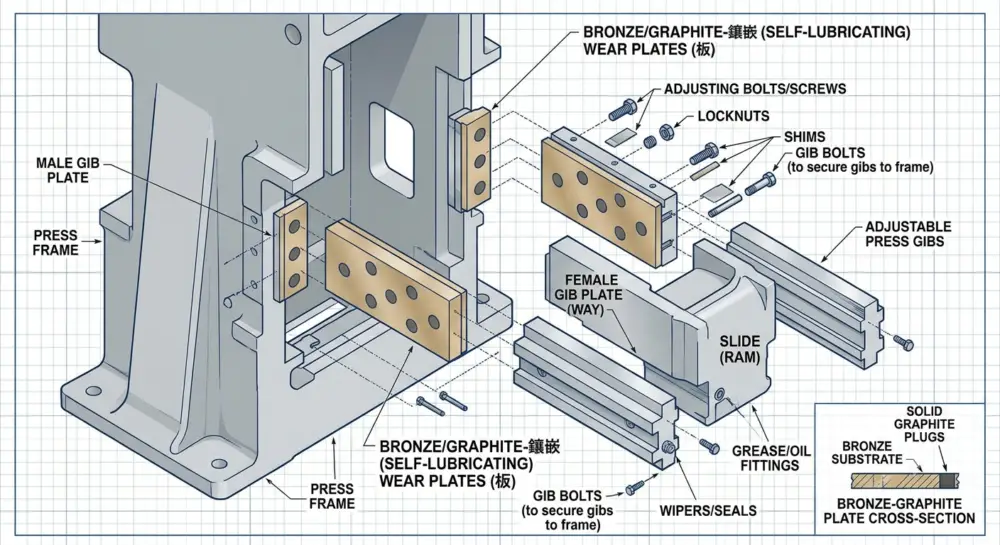
The short answer is that standard steel shims cannot handle 100-ton static loads in infrastructure moving because the compressive stress exceeds the shim material’s yield strength, causing plastic deformation and cold welding. Self-lubricating bronze graphite shims solve this by combining high compressive strength with a built-in dry lubricant that prevents metal-to-metal adhesion under extreme pressure.
Why Standard Steel Shims Fail Under Heavy Static Loads
A 100-ton load distributed over a 300 mm by 300 mm shim produces a bearing pressure of approximately 11 MPa or 1600 PSI. That number is well within the range of many structural steels. But the problem is not static strength — it is what happens at the interface when the structure moves.
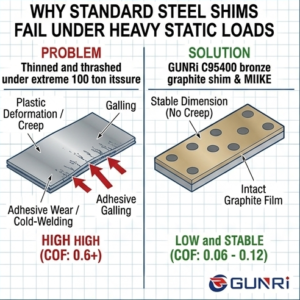
Steel-on-steel sliding under high static load creates a condition called adhesive wear or galling. Microscopic surface asperities weld together under pressure. When the structure moves, these welds break, tearing material from one surface and depositing it on the other. The coefficient of friction under these conditions can spike from 0.15 to 0.6 or higher. The Piping Technology Bronzphite slide plate guide documents that bronze graphite slide plates maintain a coefficient of friction of 0.06 to 0.12 under loads up to 5000 PSI — a range that steel shims cannot sustain under sliding conditions.
The second failure mode is creep. Under sustained static load, steel shims thinner than 3 mm can creep over time, changing the elevation of the supported structure. For bridge bearing replacement or building jacking, elevation changes of even 1 to 2 mm can cause redistribution of loads that damages existing structural elements.
Bronzelube’s technical data shows that bronze graphite slide plates have a static load capacity of up to 5000 PSI (34.5 MPa) with no creep at ambient temperature, and maintain stable dimensions under continuous loading for years.
Choose the Right Bronze Graphite Grade for Heavy Static Loads
Not all bronze alloys are suitable for 100-ton class infrastructure moving. The alloy selection must prioritize compressive yield strength over sliding wear resistance, because the primary load is static.
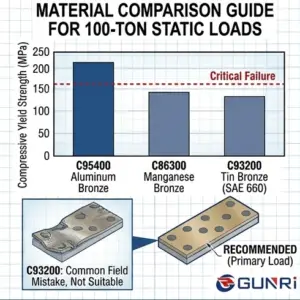
For structural jacking and skidding applications, C95400 aluminum bronze (CuAl10Ni5Fe4) per ASTM B148 is the most commonly specified grade. Its minimum compressive yield strength is 270 MPa (39,000 PSI), with an ultimate tensile strength of 620 MPa. The material withstands bearing pressures of 35 to 50 MPa without measurable deformation.
C86300 manganese bronze (CuZn25Al6Fe3Mn3) offers even higher compressive strength — up to 480 MPa yield — but is more brittle and less corrosion-resistant. It is suitable for short-duration skidding operations in dry conditions but not for long-term bridge bearing shims.
C93200 tin bronze (SAE 660) has only 120 MPa compressive yield strength. It is not suitable for 100-ton static loads. Yet it is the most common off-the-shelf bronze, and contractors frequently grab it by mistake.
The graphite plug configuration should follow the standard 30 to 35 percent surface coverage recommended by Bronzelube and other manufacturers. The plugs should be 6 to 10 mm in diameter, spaced in a staggered pattern. For 100-ton applications where the shim may stay in place for months before the structure is moved, specify a graphite grade with higher density (above 1.75 g/cm³) to reduce the rate of lubricant transfer during idle periods.
Size the Shim Area Based on Concrete Bearing Capacity
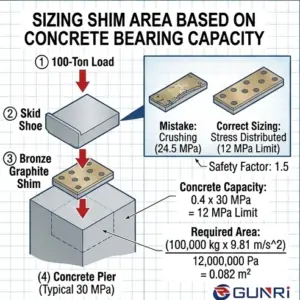
The shim area calculation is driven by the concrete bearing capacity, not the bronze shim strength. Bronze graphite can handle 35 MPa bearing stress, but structural concrete (typical 25 to 35 MPa compressive strength) can only bear 0.4 times its cylinder strength in bearing — around 10 to 14 MPa for standard-grade concrete — per ACI 318 limits.
For a 100-ton load on a concrete pier with 30 MPa concrete:
– Allowable concrete bearing stress: 0.4 × 30 = 12 MPa
– Required shim area: 100,000 kg × 9.81 m/s² ÷ 12,000,000 Pa = 0.082 m²
– Minimum shim dimensions: 290 mm × 290 mm, or 250 mm × 330 mm
A common field mistake is sizing the shim only to match the skid shoe base plate dimensions, ignoring the concrete bearing capacity. If the shoe base plate is 200 mm × 200 mm (0.04 m²), the concrete bearing stress would be 24.5 MPa — double the allowable limit — which can cause concrete crushing at the shim edge.
In practice, a 10 to 20 percent oversize factor should be added to account for uneven bearing due to surface irregularities. The Lubrite Technologies structural bearing guide recommends a minimum safety factor of 1.5 on concrete bearing stress for self-lubricating slide plates under permanent static load.
Install Shims with Proper Mating Surface Preparation
Proper installation makes the difference between a successful infrastructure move and a stuck structure. The mating surface — the concrete or steel surface against which the bronze graphite shim bears — must be prepared to a specific finish.
For concrete bearing surfaces, the surface should be ground flat to within 0.5 mm over 1 meter, with no voids or honeycombing in the top 10 mm. Apply a 2 mm layer of high-compression grout (minimum 60 MPa compressive strength) between the concrete and a steel distribution plate, then set the bronze graphite shim on the steel plate.
For steel-to-steel skidding applications, the mating surface (typically the bottom of the skid shoe or the steel distribution plate) should have a surface finish of 0.4 to 0.8 micrometers Ra. Polished stainless steel is the ideal mating surface for graphite-impregnated bronze, as confirmed by multiple manufacturers including Piping Tech and Bronzelube. The polished surface allows the graphite transfer film to form properly and reduces initial break-in friction.
Never use lubricating grease between the bronze graphite shim and the mating surface. The graphite plugs provide all necessary lubrication. Grease will attract dust and grit that abrades the bronze surface and accelerates wear.
For bridge bearing replacement where the shims will remain in place permanently, Piping Tech specifies tack welding the steel backing plate of the Bronzphite assembly to the substrate, with a 6 mm fillet weld along the outside edge. The upper element — polished stainless steel — is welded to the bottom of the superstructure.
Calculate Friction Force for Skidding vs Static Support
The friction force that must be overcome to move a structure on bronze graphite shims depends on whether the shim is being used as a permanent static bearing or as a temporary skidding interface.
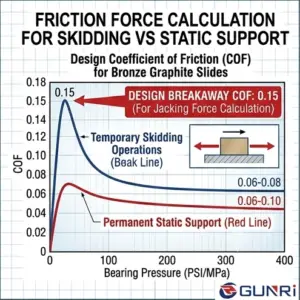
For permanent bridge bearings or structural supports, the coefficient of friction for bronze graphite on polished stainless steel under static load is 0.06 to 0.10, based on Piping Tech’s published data and verified by field measurements. For a 100-ton structure, the breakaway force is 100 × 9.81 × 0.08 = 7,848 N (approximately 8 kN or 0.8 tons) per shim. This is low enough that thermal expansion can overcome it, which is the purpose of a slide bearing.
For temporary skidding operations, the coefficient increases to 0.10 to 0.15 during the initial break-in, then drops to 0.06 to 0.08 once the graphite transfer film is established. Jacking force should be calculated using 0.15 as the design coefficient to account for break-in, shim alignment, and temperature effects.
The standard graphite plug density of 30 to 35 percent surface coverage, as specified by Bronzelube and Piping Tech, provides enough lubricant for both short-duration skidding moves and long-term static support. For moves exceeding 50 meters of total sliding distance, a higher plug density of 40 to 45 percent should be specified, as the graphite consumption rate increases with sliding distance.
A real example from a 2,000-ton building relocation in China used 12 bronze graphite shims sized 400 mm × 400 mm, spaced under the transfer beams. The measured breakaway force was 18 kN per shim — consistent with a coefficient of friction of 0.09 — and the building was moved 85 meters over two days with no measurable shim wear.
FAQ
Can I use bronze shim stock from a metal supplier for infrastructure moving?
Standard bronze shim stock (0.05 to 0.5 mm thick) is too thin to support 100-ton loads. It will extrude under pressure. You need machined bronze graphite plates 6 mm or thicker, sized to the calculated bearing area. Shim stock is only suitable for fine alignment adjustment, not primary load bearing.
How many times can a bronze graphite shim be reused?
For skidding operations, a bronze graphite shim can typically be reused 3 to 5 times before the graphite plugs are depleted below 50 percent of original depth. For permanent structural bearings, the shim should not be reused — it should remain in service for the design life.
What is the maximum temperature for bronze graphite shims under static load?
Bronze graphite retains its compressive strength up to 500°F (260°C) per published specifications from multiple manufacturers. Beyond that, the bronze matrix begins to soften. The graphite lubricant itself is stable to over 1000°F in inert environments.
Do I need to drill bolt holes in the bronze graphite shim for permanent installations?
No. Bronze graphite slide plates for structural bearings are typically held in place by a steel backing plate that is welded to the substrate. The bronze plate itself is bolted or riveted to the backing plate. Drilling through the bronze plate should be avoided because it disrupts the graphite pattern and creates stress concentration points.
What inspection is needed after installing permanent bronze graphite shims under a structure?
Annual inspection of the visible edge of the shim for graphite loss, bronze corrosion, and edge cracking. Measure the gap between the structure and the support at quarterly intervals for the first year to confirm no settlement or creep is occurring. If the elevation changes by more than 0.2 mm per year, the shim may be creeping under load and needs replacement.