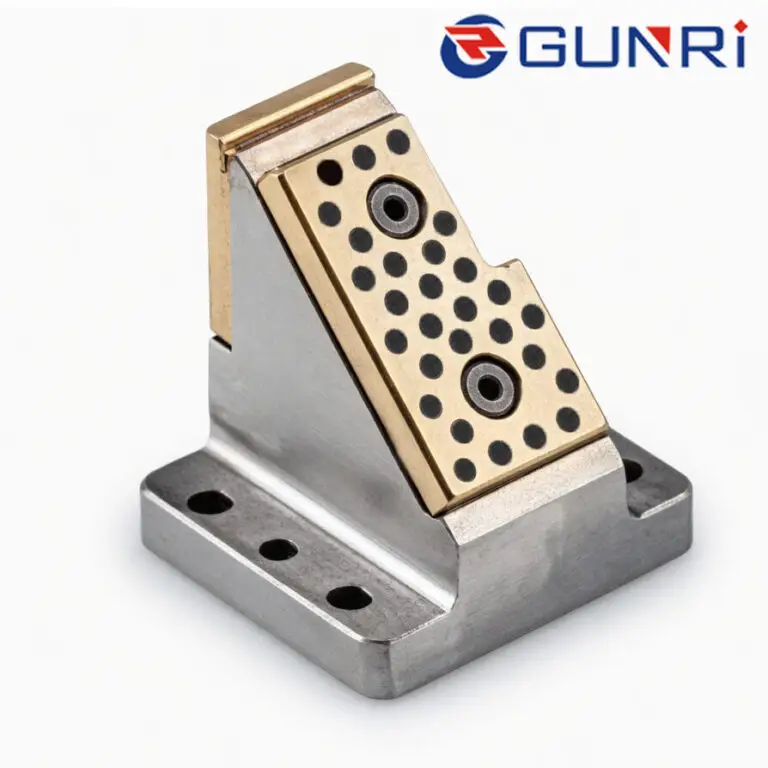
Why Are the Graphite Plugs Falling Out of Our Oilless Guide Plates During Operation?
Last quarter, a procurement manager from a German automotive Tier 1 forwarded me a photo I have seen more times than I can count. A row of empty holes where graphite plugs used to be. The oilless guide plates were only six months into production on a 600-ton progressive die, and the graphite plugs had started falling out during operation. The loose plugs were contaminating the die space, leaving abrasive graphite dust on the strip and scoring the guide rails. His question was direct: is this a bad batch, or is this a design problem?
Graphite plugs fall out of oilless guide plates primarily because the interference fit between the plug and the drilled pocket is insufficient to withstand the thermal and mechanical forces of operation. In a properly manufactured plate, each graphite plug is pressed into a precisely reamed hole with an interference of 0.05–0.15 mm, depending on the plug diameter and the bronze alloy. When that interference is too low — whether from oversized drilling, undersized plug diameter, or excessive wear of the reaming tool — the plug has no mechanical retention. The cyclic expansion and contraction of the bronze carrier during temperature changes, combined with vibration from the stamping process, gradually works the loose plug out of its pocket.
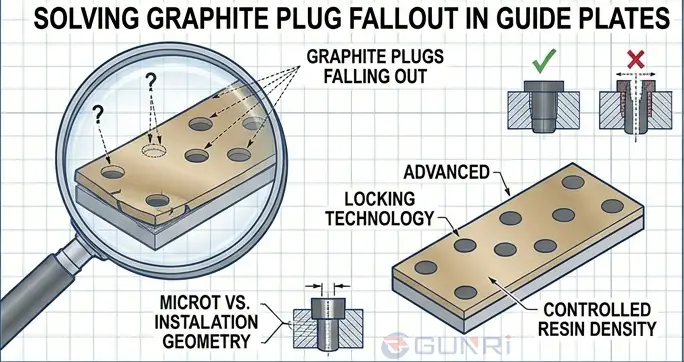
Cause #1: Insufficient Interference Fit — The Root Cause
The interference fit is the only mechanism holding a graphite plug in place. There is no adhesive, no mechanical lock, and no secondary retention feature in a standard oilless wear plate. The plug relies entirely on the compressive force of the bronze wall gripping the graphite cylinder.
For a 6 mm diameter graphite plug in an aluminum-bronze carrier, the correct interference is 0.08–0.12 mm. This means the drilled hole should be 5.88–5.92 mm before the plug is pressed in. If the hole is drilled at 5.95 mm or larger, the interference drops below 0.05 mm and the plug is loose from day one. It may not fall out immediately — the press fit holds during static inspection — but the first thermal cycle or mechanical shock will dislodge it.
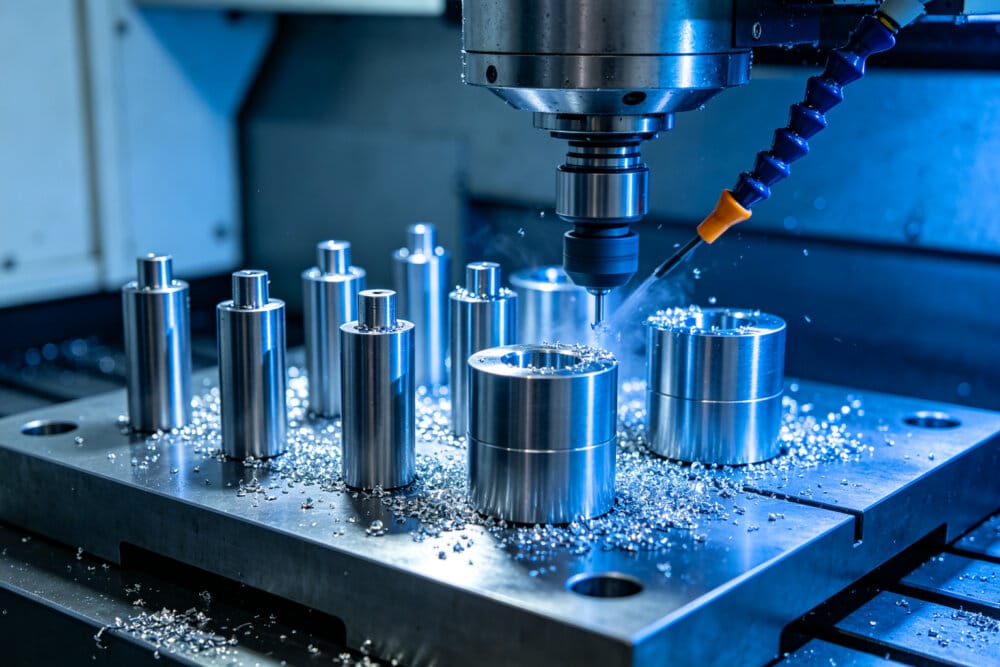
The most common manufacturing defect we see in failed plates is drill bit wear. High-volume drilling of bronze generates heat and abrasive chip flow that wears the drill diameter progressively. A shop drilling 500 plug holes without checking the finished hole diameter every 50 holes will drift from 5.90 mm to 6.00 mm or larger by the end of the run. Every plug installed in those oversized holes is a future failure.
Cause #2: Thermal Cycling Mismatch Between Bronze and Graphite
Even with a correct interference fit at room temperature, thermal cycling can loosen the grip over time. Aluminum-bronze has a coefficient of thermal expansion of approximately 16–18 × 10⁻⁶ /°C. Graphite, depending on the grade, expands at roughly 2–4 × 10⁻⁶ /°C in the axial direction. When the plate heats up during operation — which can reach 60–80°C in a high-cycle stamping die — the bronze pocket expands more than the graphite plug. This differential expansion temporarily reduces the interference.
In a well-manufactured plate with proper initial interference, the bronze contracts back to its original dimensions when it cools, restoring full grip. But in a marginal-fit plate — one where the interference was on the low end of tolerance to begin with — repeated thermal cycling causes incremental micromovement of the plug within the pocket. Each cycle shifts the plug a fraction of a millimeter outward. After several thousand cycles, the plug has walked itself out far enough that vibration or fluid pressure completes the job.
Cause #3: Heavy Grease Creating Hydraulic Suction
This is the most counterintuitive cause and the one most often overlooked by maintenance teams. Many shops apply heavy grease or EP oil to oilless guide plates, assuming that extra lubrication cannot hurt. In reality, heavy grease creates a hydraulic suction effect that pulls graphite plugs out of their pockets.
Here is the mechanism: when the mating steel surface slides across the wear plate, it shears the grease film and forces it into the capillary gap between the graphite plug and the bronze wall. On the return stroke, the sliding surface pulls away, creating a momentary negative pressure in the gap. That suction force, repeated tens of thousands of times, gradually extracts the plug. The thicker the grease, the stronger the suction.
This is why manufacturers of graphite-embedded bronze plates explicitly specify light oil only, or no additional lubrication at all. The graphite is designed to be the lubricant. Adding heavy grease does not improve performance — it actively damages the plate.
Cause #4: High-Frequency Vibration and Shock Loading
In high-cycle automotive stamping applications — particularly progressive dies running at 30+ strokes per minute — the guide plates are subjected to continuous mechanical shock. Each stroke delivers an impact load to the slide guidance system. The resulting micro-vibration propagates through the bronze plate and acts on every graphite plug.
For plugs with adequate interference fit, this vibration is harmless. But for plugs that are already loose from one of the causes above, vibration acts as the final extraction mechanism. The plug vibrates incrementally outward over thousands of cycles. Operators often notice a gradual accumulation of graphite dust on the guide rail surface before the plug actually falls out — this dust is the plug slowly wearing itself down against the pocket edge as it vibrates.
How to Diagnose the Root Cause in Your Plates
If you have plates with missing plugs, here is a quick diagnostic framework:
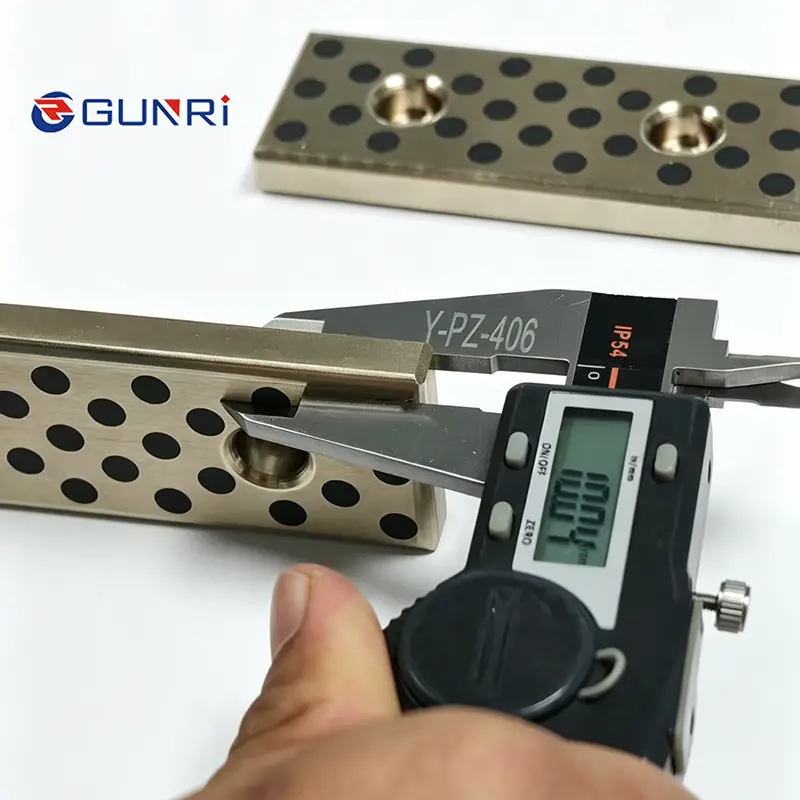
- Measure the empty hole diameter. Use a pin gauge or bore micrometer. If the hole is 0.05 mm or more above the nominal plug diameter, the cause is manufacturing tolerance drift. Your supplier is not controlling drill wear.
- Check the lubrication record. If the maintenance team has been applying grease to an oilless plate, stop immediately. Switch to dry operation or light oil only and monitor whether plug loss continues.
- Examine the mating steel surface. If you find graphite transfer film on the rail but also see scoring or uneven wear, thermal cycling is likely the primary cause. Consider switching to a bronze alloy with a coefficient of thermal expansion closer to that of the graphite grade being used.
- Review the application parameters. If the press runs at 40+ SPM with frequent shock loads, consider specifying plates with larger-diameter graphite plugs. A 10 mm plug with the same interference ratio has significantly more retention force than a 6 mm plug because of the larger circumferential contact area.
Frequently Asked Questions
Q: Can graphite plugs be reinserted if they fall out during operation?
A: Technically yes, but it is not recommended. The pocket is likely worn or oversized from the initial failure, and a replacement plug of the same diameter will not hold. The correct repair is to drill and ream the pocket to the next standard plug size and install an oversized plug. This requires removing the plate and sending it to a machine shop.
Q: Does the graphite grade affect plug retention?
A: Yes. Softer graphite grades expand less under heat and provide less frictional grip against the bronze wall. For high-temperature or high-vibration applications, specify a graphite grade with higher flexural strength and a coefficient of thermal expansion matched to the carrier alloy. Your oilless wear plate supplier should provide the graphite grade specification on request.
Q: How long should graphite plugs last in normal operation?
A: In a properly manufactured plate with correct interference fit and no heavy grease contamination, the graphite plugs should last the full service life of the bronze carrier — typically 2–3 years in high-cycle automotive stamping, or 5–7 years in lower-speed industrial applications. The graphite wears down evenly as the plate wears, maintaining consistent lubrication film throughout.
Q: Are there manufacturing standards for graphite plug retention in oilless plates?
A: There is no universal ISO or DIN standard specifically for graphite plug retention force. However, reputable manufacturers follow internal quality standards: typical acceptance criteria require a minimum push-out force of 50 N for 6 mm plugs and 120 N for 10 mm plugs. Your factory should be able to provide this data from their incoming inspection records.