Nitrogen Gas Springs vs Coil Springs: Why Stamping Die Engineers Are Switching
A few months ago, I was on the phone with a die shop in Guangdong. They had a problem: a deep-draw die with 14 coil springs that kept breaking after 80,000 strokes. Every three weeks, they stopped the press, swapped springs, and swallowed the downtime. When I suggested nitrogen gas springs, the owner hesitated. “Aren’t those expensive?”
Fair question. On paper, a nitrogen gas spring costs more upfront than a comparable coil spring. But when you run the math on cycle life, press uptime, and maintenance labor, the picture flips. In this article, I’ll walk you through exactly how nitrogen gas springs compare to conventional coil springs — no fluff, just what I’ve seen work on actual production floors.
What Makes Nitrogen Gas Springs Different
Before we compare, let’s get clear on the core difference. A coil spring stores mechanical energy in twisted steel. A nitrogen gas spring stores energy in compressed nitrogen gas sealed inside a cylinder. That might sound like a minor engineering detail, but it changes everything — force consistency, lifespan, and how you design the die itself.
Gunri nitrogen gas springs are built to meet the European Pressure Equipment Directive, with piston rods finished to Ra0.02µm or better and seals sourced from Europe. That matters because the seal is the single most failure-prone component in a gas spring, and cheap seals leak.
Space Efficiency: The Hidden Advantage
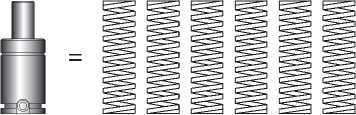
Here’s something die designers notice immediately: nitrogen gas springs deliver more force in a smaller package. A typical coil spring needs a certain wire diameter, coil count, and free length to hit its rated load. A gas spring achieves the same force in roughly half the space.
Space-Efficient Design: Engineered for minimal spatial impact, Gunri nitrogen gas springs let you pack more force into tight die sections where a coil spring simply would not fit. This is especially useful in progressive dies where every millimeter of real estate is already spoken for.
Compact Height Installation
If you have ever tried to squeeze a coil spring into a shallow die base, you already know the pain: you either stack springs (bad idea) or redesign the base plate.
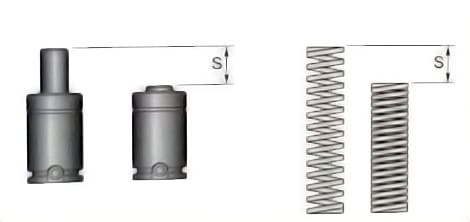
Compact Height Installation: Designed to fit into confined spaces, gas springs excel in installations with limited vertical clearance. They maintain full stroke length at a fraction of the closed height a coil spring would require.
Force Consistency: The Real Game-Changer
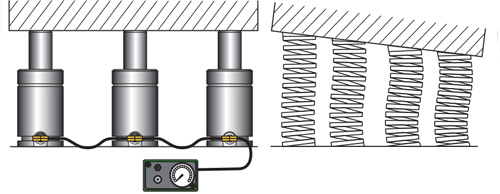
This is the number one reason engineers I know switch to gas springs and never go back. A coil spring’s force changes as it compresses — the further you push it, the harder it pushes back. That variable force can cause inconsistent pad pressure, part wrinkling, or even spring surge at high speeds.
Nitrogen gas springs behave differently. They deliver nearly flat force through the entire stroke.
Balanced Force: Experience uniform force distribution with Gunri nitrogen gas springs, delivering balanced pressure for consistent performance across different tasks. No more tuning your die around the spring rate curve.
How Pressure Stability Affects Your Parts
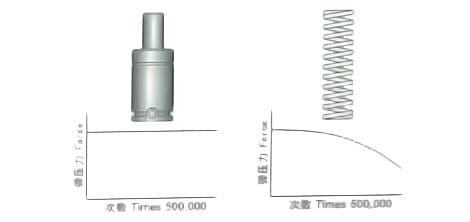
That flat force curve is not just convenient — it directly translates to better part quality. With consistent pressure, you eliminate the variability that creeps in when a coil spring approaches the end of its stroke. For tight-tolerance stamping, this alone can justify the switch.
Consistent Pressure: Enjoy unwavering performance with a constant pressure output from Gunri nitrogen gas springs, ensuring dependable and repeatable results. Your 1,000th part will look exactly like your first.
Instant Force on Contact
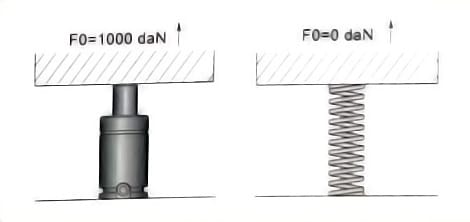
Another practical difference: coil springs require preload. You have to compress them before they generate any useful force, which eats into your available stroke. Nitrogen gas springs produce force the moment the pad touches the material.
Initial Pressure: These springs are equipped with an initial pressure setting, providing instant force upon application and streamlining your operational processes. No preload, no wasted stroke.
Long-Term Cost Comparison
Let’s talk money. A high-quality coil spring might last 500,000 cycles in light duty. A Gunri nitrogen gas spring is rated for 1 million cycles or 100 kilometers of stroke — whichever comes first. In practice, I have seen them run past 2 million cycles on moderate loads.
Initial Pressure: These springs are equipped with an initial pressure setting, providing instant force upon application and streamlining your operational processes. When you factor in replacement labor, press downtime, and scrap reduction, the total cost of ownership actually favors the gas spring in most medium-to-high volume runs.
When Coil Springs Still Make Sense
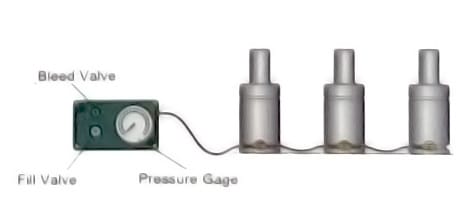
I would be lying if I said gas springs are always the answer. For very low-volume prototyping (under 10,000 cycles total), or for dies where you need extreme stroke length beyond what standard gas springs offer, coil springs remain a practical choice. They are also simpler to replace without specialized knowledge about nitrogen charging pressure.
But for production stamping — progressive dies, transfer dies, line dies running 100,000+ cycles per month — the gas spring wins on almost every metric: space, force consistency, lifespan, and total cost.
Making the Switch
If you are evaluating nitrogen gas springs for your next die build, I would suggest starting with a single station or a high-wear position. Compare the performance yourself. In my experience, once you feel the difference in consistent pad pressure and see the elimination of mid-run spring changes, there is no going back.
For a full overview of available series, force ranges, and mounting options, check out our nitrogen gas springs product page. If you have a specific application in mind, contact our engineering team — we can help you match the right spring to your die.