Custom Ball Cages Made to Your Drawing
You have a die set that needs a guide cage with a 38 mm bore and twelve 5/32 inch balls spaced at a pitch the off-the-shelf catalog does not carry. The standard parts leave a 0.4 mm gap in the carriage, and the slide binds after 200 strokes. You cannot buy what you need from a catalog, so the part has to be made.
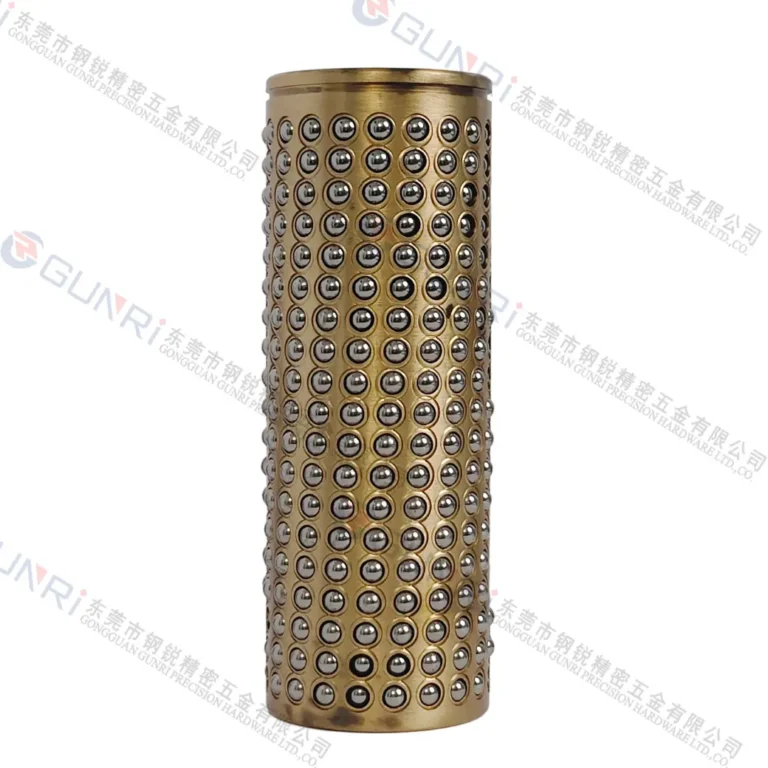
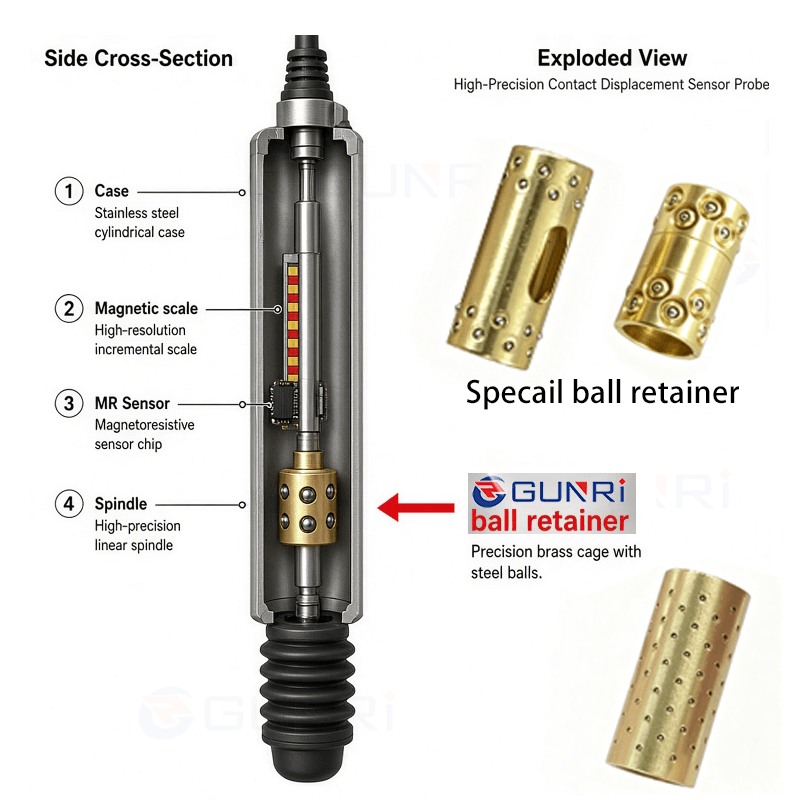
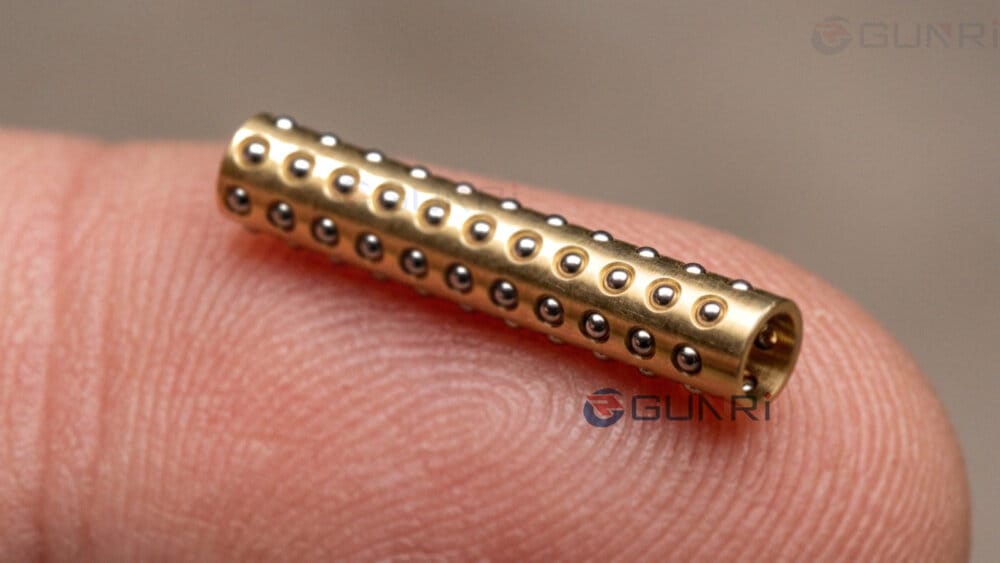
A custom ball cage is a machined or staked ball retainer built to your drawing rather than to a supplier’s standard dimension list. It holds a precise row of bearing balls between two mating surfaces — usually a guide post and a guide bushing, or a shaft and a sleeve — and lets them roll with controlled contact instead of sliding. We machine the pocket pattern, stake the balls in, and inspect the result against your print.
Why engineers spec a custom cage instead of a catalog part
Catalog cages cover common bore ranges and ball sizes. They do not cover everything. Engineers move to a custom cage when one of the following is true:
- The envelope does not fit a standard bore, OD, or length — for example a probe housing squeezed inside a Ø6 mm barrel.
- The ball count, pocket pitch, or row arrangement must match an existing shaft or bushing that is already in production.
- The cage has to clear a slot, an oil groove, a lubrication channel, or a sensor feature on the same ID.
- The standard cage is obsolete, and you need a drop-in equivalent of an Agathon, MISUMI, or FIBRO part for a die set still on the floor.
- You are prototyping an actuator and need a one-off before committing to tooling.
A custom cage is not an upgrade for its own sake. It is the part you draw when the standard envelope stops matching your mechanism.
Materials we machine cages from
We build cages in three families of material, chosen against the application rather than against a catalog default:
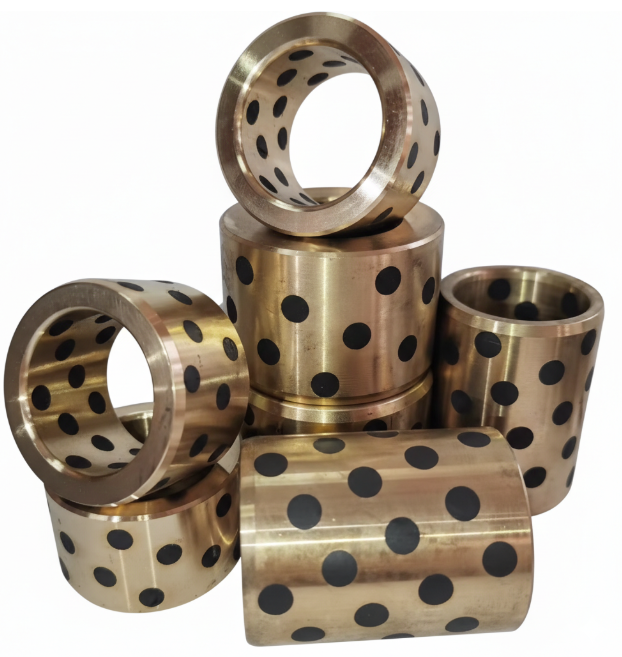
- Brass and bronze — the default for stamping die guides, probe cages, and most general linear guidance. Brass machines cleanly, holds a sharp pocket edge, and is forgiving against hardened shafts. Bronze is specified when a graphite solid-lubricant plug is required for low-oil or oil-free service.
- Aluminum alloy — chosen when inertia matters, for moving carriages and high-speed slides. Aluminum does not carry the wear life of brass against a hardened post, so it is paired with a hardened shaft and a defined duty cycle.
- POM resin — a self-lubricating polymer for light-load, low-friction guidance where oil is unwanted, such as food-contact, cleanroom, or optical positioning.
Brass is the starting point for most cages that leave our shop. Read more on when to specify brass for a ball cage and on cage material trade-offs.
The envelope we work in
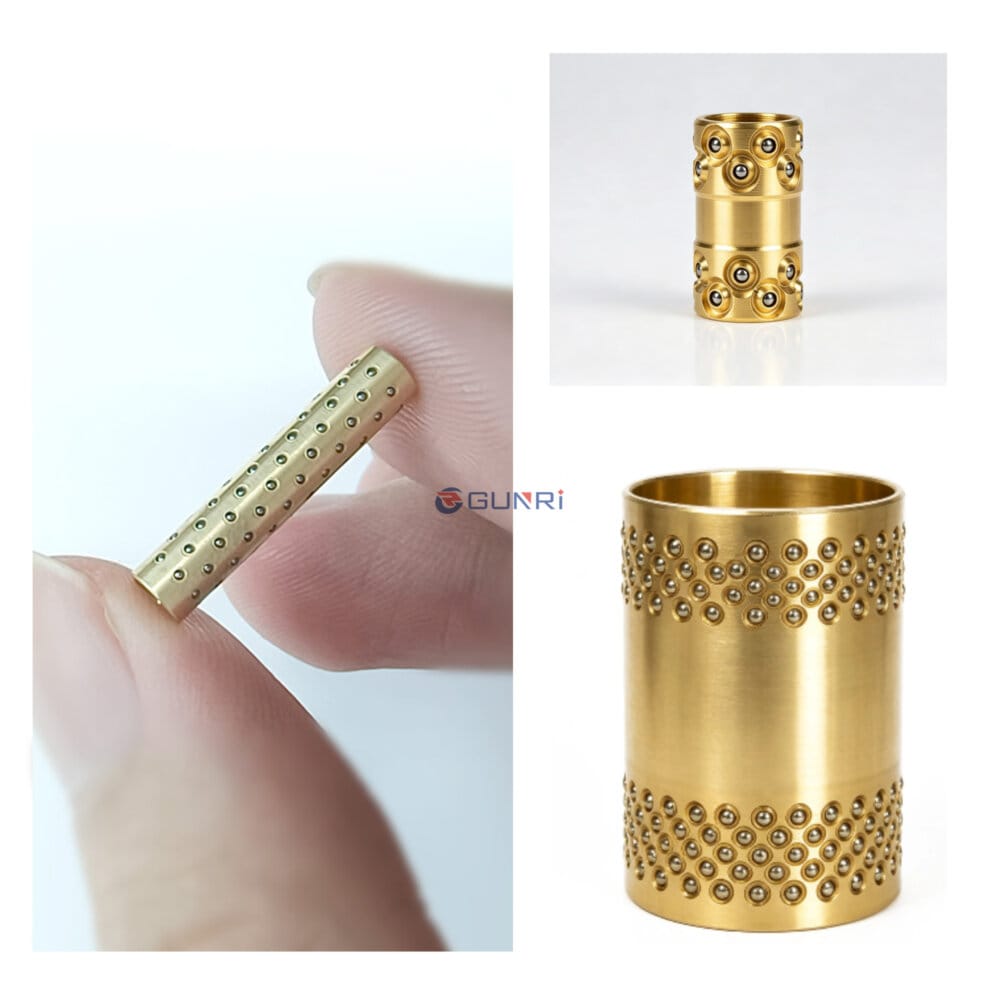
Our machining and staking setup covers a wide range without special tooling. The miniature end of the range starts at a 2.0 mm inner diameter with 0.6 mm balls and an 8 mm minimum length — small enough for displacement probes and miniature actuator barrels. The large end runs up to 400 mm OD, which covers press and die-set cages well beyond the common catalog sizes.
Inside that envelope we machine custom geometry: slotted windows for side loading, oil grooves for lubrication feed, and multi-row ball arrangements when the load path needs more than one row of balls. We do not force every customer into a single row of equally spaced pockets.
How the balls are retained
The balls are held by staking — a mechanical caulking operation that deforms the cage edge around each ball so it cannot fall out under axial load. Staking is what separates a machined pocket from a finished, serviceable retainer. The ball must rotate freely in the pocket but cannot extract under pull. We control the stake around each ball so that the ball is captive yet still turns, which is the condition the mechanism needs for low friction.
For a longer explanation of the process, see how ball cages are staked. If you are evaluating a molded retainer against a machined-and-staked one, staked vs. molded ball retainers lays out the trade-offs.
Interchange and equivalent parts
A large share of our custom work is replacing a cage that already exists on the floor. We build drop-in equivalents of Agathon, MISUMI, and FIBRO die-set ball cages when the original is obsolete, when the lead time is too long, or when the customer wants a local source. To mirror a part we need either the original drawing, a sample, or the supplier part number and the measured envelope. More on this process is in Agathon / MISUMI / FIBRO ball cage equivalents.
Inspection against the drawing
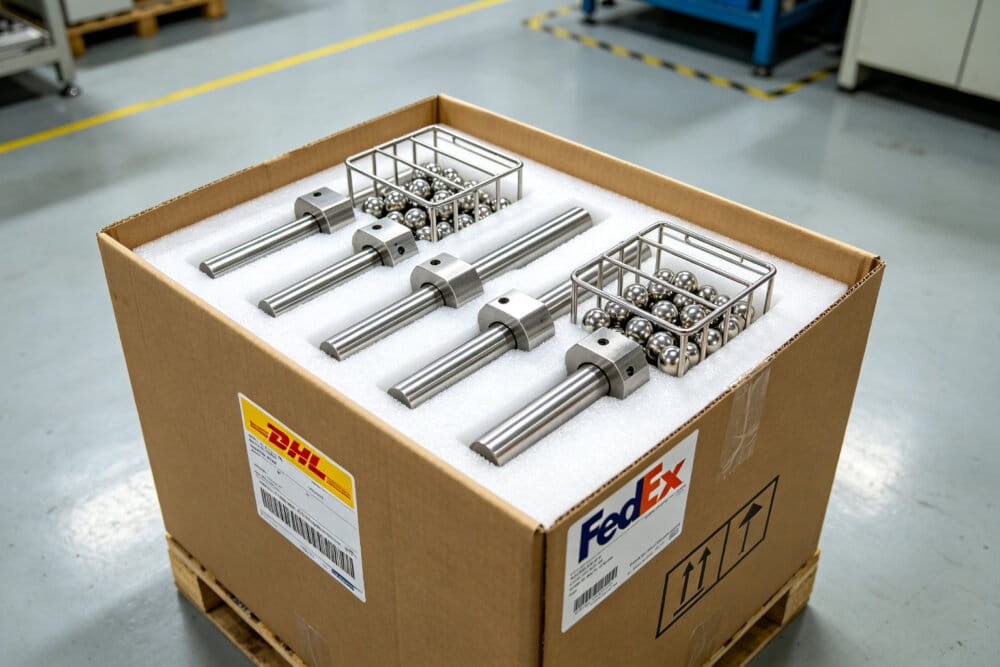
Every cage we ship is inspected on a coordinate measuring machine against your drawing. We check ball pocket location, pocket runout, ID, OD, and length, and we pack an inspection report with the shipment. Pocket location is the dimension that governs repeatability in the slide — if the pockets wander, the ball spacing wanders, and the carriage feels rough after a few millimeters of travel. Our CMM inspection is covered in detail in precision ball cages CMM-inspected to drawing.
No minimum order
We do not impose a minimum order quantity. A prototype single piece for a development program runs through the same CMM inspection as a 500-piece batch. This matters for OEM customers in metrology, medical, and semiconductor equipment who are still proving the mechanism and cannot commit to a production run. The path from prototype to batch is described in no-MOQ ball cage prototyping.
How to order a custom ball cage
The order starts with a drawing. We accept STEP, IGES, and SolidWorks (SLDPRT) files along with a 2D PDF. Send the model, the key dimensions, the material, the ball specification, the quantity, and the inspection level you need. If you only have a sample, send that — we can reverse-engineer the envelope and pocket pattern and confirm the spec back to you before cutting metal.
What we need on the drawing, and what happens after you send it, is broken out in what we need to quote your custom ball cage.
Send your drawing or a sample to our engineering team for a no-obligation review. We accept STEP, IGES, and SLDPRT files. Every cage is CMM-inspected before shipment.