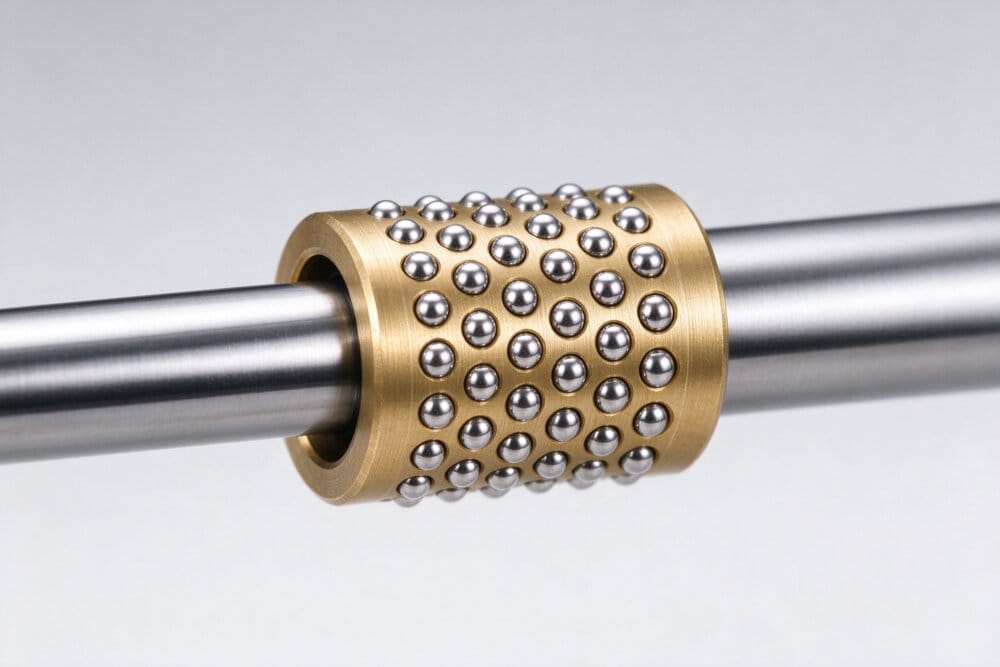
Custom Miniature Ball Bearing Guide Sets
A miniature linear stage needs a finite-stroke guide: a hardened shaft pressed into one plate, a mating sleeve in the other, and a short ball cage between them that runs the full stroke without the balls cycling end to end. The catalog guide sets cover common shaft diameters. The stage you are building has a 4 mm shaft and a 12 mm stroke, and the catalog set is either too long or too stiff. You need the three components — shaft, sleeve, cage — built together to your geometry.
We build custom miniature ball bearing guide sets: a hardened shaft, a mating sleeve, and a staked ball cage between them, sized as a unit to your envelope. The set is a finite-stroke linear guide in the MISUMI style, but with the shaft diameter, sleeve length, cage length, and ball arrangement drawn to your application rather than to a catalog row.
What a finite-stroke guide set is
A finite-stroke ball guide does not use an endless ball loop. It uses a short cage carrying a fixed row of balls that travels with the carriage. The stroke is limited by the cage length — the balls run along the shaft between the ends of the sleeve, and the cage moves with the carriage. There is no return tube, no recirculating loop, and no cartridge bearing to press in. The set is three simple parts: shaft, sleeve, cage.
This is the right geometry for short-travel stages: microscope XY drives, fiber alignment fixtures, syringe pump plungers, SMT nozzle Z axes, and small actuator barrels. Where the travel is a few millimeters to tens of millimeters, a recirculating linear bearing is overkill. A finite-stroke set is shorter, stiffer in the package, and easier to assemble.
The three components, built together
Shaft
The shaft is hardened and ground to the diameter your mechanism requires. It is the raceway the balls run on, so the diameter and the surface finish are dimensioned on your drawing. We do not stock a shaft diameter list — we cut to your bore.
Sleeve
The sleeve is the mating bore that the cage OD sits in. It is the housing-side component, pressed or screwed into the stage plate. The sleeve ID and the cage OD are matched as a pair so the cage runs concentric between shaft and sleeve.
Cage
The cage is the staked ball retainer that carries the balls between shaft and sleeve. It is machined to the envelope, the balls are staked in, and the pocket pattern is CMM-inspected. The cage length sets the stroke: a longer cage gives a longer stroke in a given package.
Custom geometry, not a catalog row
Where the catalog guide set forces you into a standard shaft diameter and a standard cage length, our custom set follows your drawing. We machine:
- Shaft and sleeve diameters outside the common catalog range, including the miniature end of the envelope down to a 2.0 mm bore.
- Cage lengths matched to your stroke, with the row of balls positioned for full travel at the ends.
- Slotted windows in the cage for side loading or lubrication access.
- Oil grooves in the sleeve or cage for lubrication feed on a running stage.
- Multi-row ball arrangements when the load path needs more than one row of balls between shaft and sleeve.
If you are evaluating a custom set against a cartridge linear bearing, ball cage vs. linear bearing lays out the trade-offs. The miniature envelope where these sets get small is in miniature ball cages at 2.0 mm ID.
Applications for the custom set
The finite-stroke set shows up in instruments where the guide has to disappear into a small package:
- Microscope and optical translation stages — short XY travel, low friction, no play.
- Syringe pump plungers and autosampler syringes — a short guide on the plunger rod.
- SMT nozzle Z axes and inkjet carriages — a small vertical guide on a moving head.
- Camera autofocus VCM barrels — a miniature set inside the lens barrel.
Related pages: ball cages for microscope XY stages, ball cages for syringe pump plungers, ball cages for SMT nozzle Z axes, and ball cages for camera autofocus VCM.
Ordering a custom guide set
Send the drawing for the shaft, the sleeve, and the cage as a set. We read the shaft diameter, the sleeve ID and OD, the cage length, the ball size, and the stroke. If you have a MISUMI part number you are trying to replace or equivalent, send it along — we will cross-reference the envelope and confirm the dimensions before quoting. The CMM report covers the cage pocket location and the shaft-to-sleeve concentricity of the set as built.
We do not impose a minimum on a custom set. A prototype three-piece set for a stage in development runs through the same CMM inspection as a batch of 200 for production. The prototype-to-batch path is in no-MOQ ball cage prototyping.
Not sure whether a cage or a bushing is right for your application? Send us the stroke, load, and available envelope, and we will tell you honestly which one makes more sense — even if it is not us.